Article: Evelyne Coussens on 'Die malle Jan' (rekto:verso)
This article was originally published in rekto:verso's special issue 'Periphery' (edition 94, 2022) under the title 'Beerlegem - Merelbeke - Ghent'. The complete dossier can be found here.
What in other circumstances would be called 'exceptional transport' is, in Die malle Jan, a symbolic journey. With an oak tree, combined human strength and a rare slowness and poetry. A report from root to crown.
In the work of artist Max Pairon, 'periphery' is not a compelling concept, any more than 'ecology' or 'spirituality'. Pairon does not work from concepts, but from tangible reality. Yet all these concepts manifest themselves, in an unemphatic way, in his project Die malle Jan.
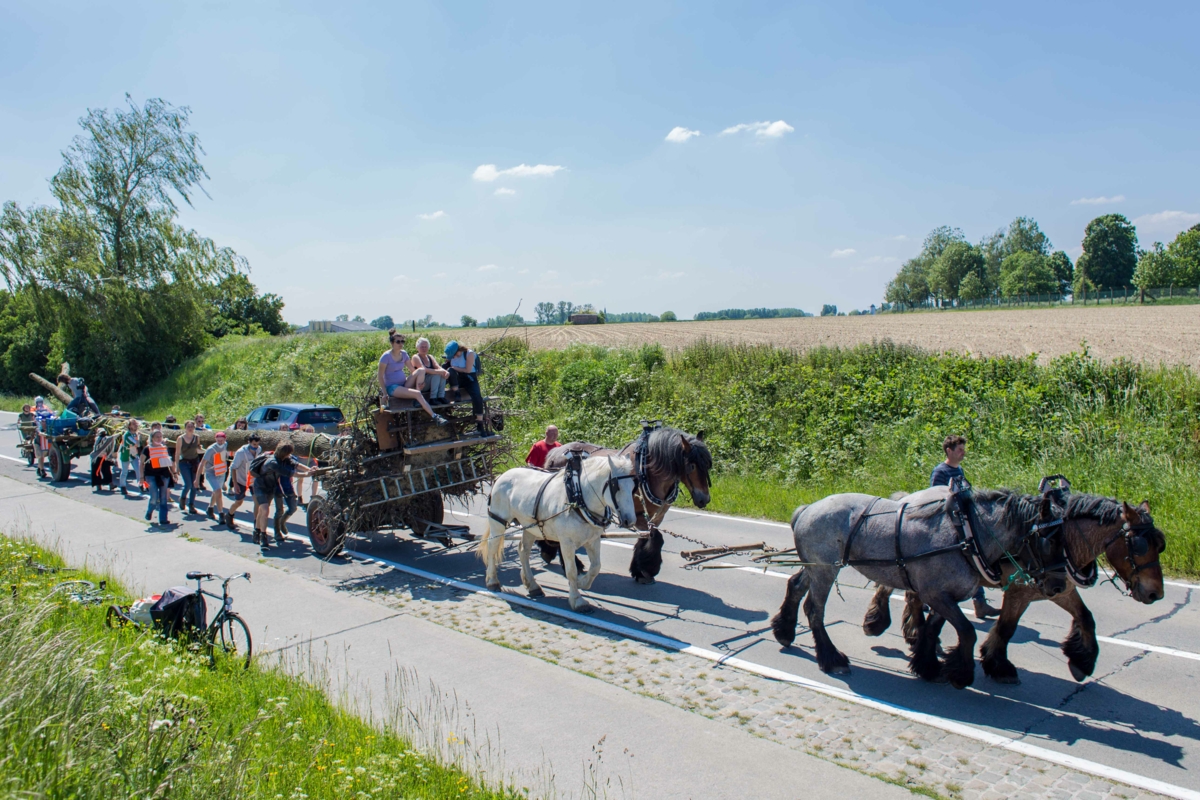
It must have been quite a shock for Jean-Pierre Demets from Beerlegem. On 31 May 2021, he opens his front door and comes face to face with Die malle Jan: 'First I saw four horses and then a huge crown of tree roots towering above them. Behind it was a procession of people, children, cyclists, homemade prams and carts. It was the strangest procession I had ever seen.' The inspiration behind this unusual procession is artist Max Pairon (°1988), who on that day will embark on a journey with 'his' oak tree, which is no less than 22 metres long: from the grounds of Bieze Castle, where the oak tree fell during a storm, to Merelbeke – the tree's first stop and resting place. In a second stage, planned for May 2022, the tree will be transported from its temporary location on Hundelgemsesteenweg to the social-artistic workshop De Koer in Brugse Poort in Ghent.
The purpose of the journey is concrete, almost banal: the oak will serve as a beam, as a support for the renovation of the studio in De Koer. But as always, a work of art is not only defined by what happens, but above all by the way in which it happens. In 2020, Pairon not only searches for a tree that meets the technical requirements (thickness, type of wood, quality of the wood, etc.), but also decides to remove the tree from the forest using manpower (and horsepower) and to transport it on a 'malle jan' – an old wooden cart made of the same material as its load. What in other circumstances would be called 'exceptional transport' is transformed by Pairon's choices into a symbolic journey. The slowness of the movement, the community that forms around the oak tree en cours de route, the energy that the participants pump into the transport and the effect of the moving tree in the landscape; all this ensures that Die malle Jan becomes an artistic journey, loaded with meaning.
Wherever Die malle Jan passes, spontaneous encounters arise between the permanent team of pushers, horses and horse drivers, and passers-by.
To begin with, there is the crossing of different layers of space and time, to which forms of community are linked. The tree departs from an old feudal given: a castle domain where a count and countess rule the roost. Surrounding it is the 'farming community' of Beerlegem (Zwalm), where Pairon – who relies on his immediate surroundings for the logistics of his business – gets to know various residents. Then it's off towards modernity, along the main road, with traffic increasing as the tree approaches the village centre. Wherever Die malle Jan passes, spontaneous encounters arise between the regular team of pushers, horses and horse drivers, and passers-by. These conversations are an integral part of the project. They form a narrative that falls outside the everyday, that pierces normal life for a day and causes a tear in reality, as poetry does. On a weekday morning in May, a 22-metre tree may glide through the streetscape.
The second part of the journey will take Die malle Jan from Merelbeke to De Koer. It is remarkable how the tree itself dictates the route. There are not a hundred routes you can take with a tree on a cart. It is either along the ring road (for which Pairon does not have permission) or straight through the historic heart of Ghent. Here, the tree will perhaps gain its greatest expressiveness, becoming the most striking scene. Pairon's choice of this traditional method of transporting the oak is linked to his fascination with looking 'behind' or 'under' things – call it a kind of artistic 'archaeology'. Who still realises that thousands of tree trunks were used in the cathedral and belfry of Ghent, all felled, sawn and incorporated into the spires by human labour? The arrival of the oak tree in the city centre confronts the city with its past and directs the gaze of bystanders to the 'nature of things': the raw materials (the natural origin of buildings and utensils) but also the skill of the people who worked those raw materials and the immeasurable human energy that was used in the process. It is as if the sweat of today's team of carders mixes with the centuries-old sweat of their historical predecessors. At the same time, it is a sneer, Pairon explains, at the sometimes static way in which we preserve the past: the ostentatiousness of such an arrogant spire is given a silly touch by the passage of one of its most basic components. Ecce homo, or rather: ecce quercus.
Anyone who asks Pairon what he is doing receives a matter-of-fact answer: he is transporting a tree from A to B, together with a community of participants and bystanders.
For those who wish to read into it, this search for the 'source' of things has a certain spirituality: over the centuries, humans have lost touch with the nature of things. First, the industrial revolution alienated them from their labour and materials through machines, then the technological revolution, with its interfaces, drove that distance to extremes. The way Pairon talks about his 'encounter' with 'his' oak tree also seems to conceal an aversion to anthropocentrism, but without this sentiment being emphasised. Nor is this the case with the potentially political interpretation of his choice of a slow and ecological mode of transport, which could be read as a critique of capitalism. These are interpretations that outsiders to the project might attribute to it, but anyone who asks Pairon what he is doing receives a sober answer: he is transporting a tree from A to B, and he is doing so together with a community of participants and bystanders. Even the obvious performative aspect of the oak tree's journey is not extremely ritualised or 'artistic'. The request to poet Peter Holvoet-Hanssen to accompany the second part of the journey has a pragmatic purpose: he is the bard who, with his verses and songs, must whip up the team of labourers. For the rest, the tree transport is not made more symbolic than it is – that would turn it into a concept again.
And Pairon does not like concepts: he starts from materials, situations, chance encounters, not from theoretical reflections. ‘You can't conceive of a project,’ he says. ‘It's a gift, you have to receive it. It has to come your way.’ And so he works with what is given, with what is available in terms of (human) material. And he starts at the root, not at the crown. This does not make the poetry of his projects any less powerful, quite the contrary.