Article: PLAN B on village dramaturgy (rekto:verso)
The team at arts platform PLAN B shared their thoughts on the arts and the countryside in the new themed issue of rekto:verso on 'Periphery' (edition 94, 2022). Three practical examples, 'Boerenpsalm' (Farmer's Psalm) by Martha Balthazar, AR-TUR platform for architecture and space, and Seasonal Neighbours were examined. Together, they outline what we might call 'village dramaturgy'.
The article also gave rise to a development project called 'Village Dramaturgy'. In 2023-2024, PLAN B will investigate what it means to be a village dramaturg in the periphery of three cities: Aalst, Genk and Brussels.
Although the countryside is the scene of important contemporary dynamics such as climate change, globalisation and housing shortages, it is rarely the subject or location of works of art. The city and the urban dweller remain the benchmark for the arts. Martha Balthazar, AR-TUR and Seasonal Neighbours use various art forms to tell stories about what is happening outside the big cities. Their stories break away from the clichéd and romanticised representation of the countryside as culturally deprived wasteland and create a complex image of a critical zone in transformation.
In recent years, the term 'urban dramaturgy' has been gaining ground in the arts. Gerardo Salinas, urban dramaturg at KVS, introduced the term. In recent years in particular, it has become common practice for city theatres in Belgium and the Netherlands, among others, to appoint an urban dramaturg or to set up projects related to urban dramaturgy. The term has as many interpretations as there are practitioners. What they share is the observation that the urban art institute does not reflect the rapidly changing contemporary reality of the city and that the stories of the city need to be told.
Dramaturgy, a practice whose definition is anything but fixed, originated in the context of text theatre. It roughly involved analysing, translating and studying a text and its performances. In the creative process, dramaturgs linked the content of this text to the current events of the time in which they were performed. In the context of urban dramaturgy, the city itself is considered to be that text.
Neither dramaturg nor village
Urban dramaturgs such as Salinas and his former colleague Tunde Adefioye make holes in the invisible walls around the theatre, allowing the theatre to better enter the city and vice versa. In MAPping Brussels (2017), for example, Brussels artists took you on a walk through the city, trying to let you see through their eyes. During Seniorenslam (2019), senior citizens from Brussels, coached by young urban slam poets, took to the stage of the KVS to share their texts. The two projects seek ways to tell the stories that take place outside the walls of the theatre. What if we extend this logic beyond the city?
A village dramaturg tries to read and interpret the village and its surroundings as a text and link that personal reading to broader phenomena. In this way, village dramaturgs succeed in representing themes, dynamics and perspectives from the countryside in their artistic projects, which are currently lacking in the arts.
The village dramaturgs in this article are artists and researchers; they have no defined function as village dramaturgs. That role does not currently exist. Through the close collaboration that each creator has with the inhabitants of a particular space, they also exert an important influence on dramaturgy, which becomes a shared responsibility within a rural network. Because dramaturgy here is detached from the role of the dramaturg, it is not bound to a single medium. Theatre, but also photography or visual arts give shape to the meanings and stories of the village.
A village dramaturgy without an explicit dramaturg, but also without a village? Because what does the village still mean today? In a thoroughly urbanised Flanders, it is difficult to hold on to the classic image of the cosy village around the church tower. The city and the village can no longer be distinguished from each other simply on a geographical basis, but are merging into so-called 'nebula cities'. They are intimately intertwined. Perhaps the village, the countryside or the rural environment exists primarily as a mental space. Persistent associations such as nostalgia, tranquillity, simplicity and naturalness surround this space and its inhabitants. Village dramaturgy could therefore just as well be called rural dramaturgy or the dramaturgy of the countryside. What is important is that the dramaturgy enters into dialogue with the specific mental spaces of the village, the countryside or the rural environment.
Non-urban stories
An important breeding ground for urban dramaturgy was the reality of a 'rapidly changing city'. This refers to dynamics such as superdiversity and gentrification. The stereotypical image of the rapidly evolving city is often contrasted with the stagnation of the countryside. But the village is also the scene of very different changes, such as the direct impact of climate change, the geographical and political isolation of communities, and the transformation of labour through globalisation and late capitalism in the form of mechanisation and seasonal work. These stories are also not yet sufficiently reflected in the arts.
If a village dramaturgy attempts to read the village as a text, what would that text have to say? The three art practices have very different answers to that question. Martha Balthazar sees in the village the trials and tribulations of contemporary farmers due to climate change and persistent price declines. AR-TUR looks at villages in the Kempen region from an architectural perspective and sees new possibilities for rural living. Seasonal Neighbours focuses on seasonal migration and related themes such as identity and globalisation.
In her Boerenpsalm (2021), Balthazar composes a text by and for the countryside in the form of an antiphonal song in which diverse and conflicting perspectives from the agricultural sector are given a voice. She spoke with policymakers, activists, employees of biotechnological multinationals, researchers and farmers, from short-chain organic farmers to industrial potato growers for McDonalds. Actors Barbara T'Jonck and Mats Vandroogenbroeck listen live through large headphones to the interviews Balthazar conducted with protagonists in the agricultural debate, after which they present them word for word to the audience.
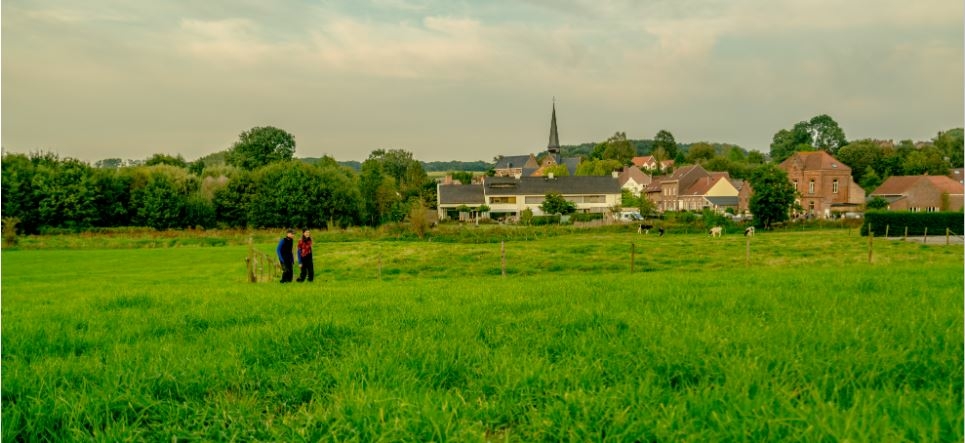
The audience sits on a grandstand in a field during each performance; Boerenpsalm does not visit theatres, as the rural context is too important for that. We ourselves experienced this performance in a field in Gaasbeek. At a carefully directed moment when the actors disappear from the 'stage', only the field and the soundtrack with interviews remain. Due to the absence of actors, the field itself seems to tell the village stories about increasing industrialisation, suicide among farmers and the disastrous personal and political consequences of climate change. A field, all too often reduced to a kind of romantic scene of innocent nature, thus begins to speak for itself.
The Gaasbeek field speaks not only for itself, but also for many other fields, as far away as India. There, Balthazar interviewed an activist during the peasant uprisings of 2020 and 2021. Millions of farmers took to the streets to protest against new neoliberal legislation that would deregulate the agricultural economy by, among other things, allowing speculation on agricultural products and scrapping minimum prices. Despite their significant impact on our lives, these 'glocal' stories from outside the city and their narrators struggle to find their way onto the stage. In Boerenpsalm, Balthazar brings them together in a polyphonic narrative of the village. She reveals a complex and ambiguous battlefield at the forefront of the global economy.
Future villages mapped out The platform for architecture and space AR-TUR,
which focuses on village architecture in the Kempen region, also interprets the village. They do not translate this view of the village into a performance, but explore architectural possibilities.
Urban dramaturgy focuses strongly on urban development and the public space of the city. Village dramaturgy, as practised by AR-TUR, looks primarily at the land in the countryside and what is being built and growing there. While urban areas in Flanders have been well mapped, much of this information is lacking in the Kempen region, for example. This perpetuates the clichéd image of the countryside as 'terra incognita'. In 2017, AR-TUR presented their Kempenatlas, a publication with an accompanying exhibition, for which they appointed professor of urban planning Maarten Van Acker as editor-in-chief and collaborated with local experts. This impressive overview links essays about the Kempen to thematic maps on land, water, mobility and culture.
Just like in the maps and essays, the landscape and buildings of the Kempen are reflected in photographs by Filip Dujardin. You see seemingly deserted village centres, but also the imposing industrial infrastructure of Soudal or Katoen Natie. These silos and factories are given as much space in the atlas as the coniferous trees, heaths and lakes that define our image of the Kempen. In one of the images, a field with horses seems to merge seamlessly into a huge attraction at the Bobbejaanland amusement park. In dialogue with the maps and texts, Dujardin develops a visual village dramaturgy that demonstrates the diversity of building forms in the Kempen landscape. This creates an exceptionally layered image of the Kempen, as a nature reserve, but also as an ideal location for modern mega-stables, giant factory buildings or prisons.
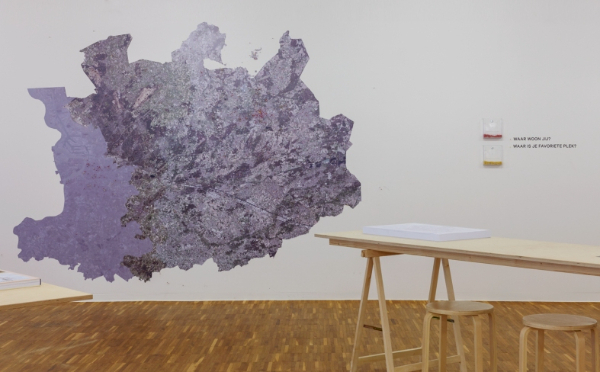
The Kempenatlas distinguishes itself from classic cartographic works not only through the importance it attaches to photography, but also through its approach to time. The maps here do not merely show what the landscape consists of, but also how it came to be that way and where it might be headed. The atlas paints a picture of a unique region in transformation. Until well into the 19th century, the Kempen was a very remote, sandy area. The region first came to the attention of planners when the government of the United Netherlands claimed land to establish so-called Benevolence Colonies in Wortel and Merksplas. It was in a region far from the big cities that policymakers saw the ideal environment for what was called an 'indigenous colony'. 130 small farms were established, where the poor from the city were sent to work the rough soil. After the Belgian Revolution, Wortel and Merksplas became the location for 'vagrant colonies' with a similar function. Today, penitentiary institutions stand where the colonies once were.
The Kempen region was not only important to the government as a place to relocate undesirable population groups, but also played a key role during industrialisation. Large-scale road and water works and the construction of industrial infrastructure were intended to make the region useful. As a result, the Kempen region today has an exceptionally strong manufacturing industry for Flanders. Based on this specific history, which has shaped the landscape, AR-TUR also outlines possible futures for the region. The creators of the atlas describe the possibilities of a climate- and water-neutral, liveable and diverse region in the future. They explain how the 19th-century water infrastructure can be used for ecological transition and how the manufacturing industry can serve local goals.
Other AR-TUR projects also explicitly depict the future of the rapidly changing village. What and how do we want to build or renovate at a time when traditional forms of housing consume too much space and energy and prefabricated apartments are becoming the norm? In the book Toolbox village architecture (2021), AR-TUR attempts to answer these questions about liveability and sustainability by studying and rethinking the architecture in the village. As with Boerenpsalm, AR-TUR's publications enable us to read the region in a different way. This multi-layered village dramaturgy does not place the village in the past, where it sometimes seems unjustly stuck, but projects it into the future.
Invisible residents The artist
collective Seasonal Neighbours also creates a different kind of image of the countryside. It does so based on the phenomenon of seasonal labour, whereby hundreds of thousands of Eastern and Southern Europeans travel to Western Europe every year to work temporarily in the agricultural sector. Seasonal Neighbours investigates this migration movement and its link to themes such as economies of scale, the way we produce food, and the place of seasonal workers in the local fabric. They do this in various artistic projects that always start from the environment of the seasonal worker. If we view the rural environment as a text, this hyper-diverse group forms an underexposed character. Seasonal Neighbours focuses precisely on this character and the way in which it helps determine the dynamics of the countryside.
The collective was founded in 2018 in Borgloon, Limburg, the heart of the Belgian fruit-growing region and the birthplace of founder Ciel Grommen. The artist-architect observed that both work and leisure time for migrant workers often take place in the farmer's private living quarters. The only time they mingled with the local population was in the local supermarket. Together with architect Maximiliaan Royakkers, they therefore created the House for Seasonal Neighbours, strategically located behind the Aldi car park. The mobile terraced house became a meeting place where seasonal workers, casual passers-by and farmers could go for a summer long for everything except work. During coffee breaks, film screenings and barbecues, people talked about the meaning of 'home' and hospitality. A round table discussion, moderated by architect-sociologist Dieter Leyssen, delved deeper into how increasingly larger agricultural businesses are leaving their mark on the Haspengouw landscape.
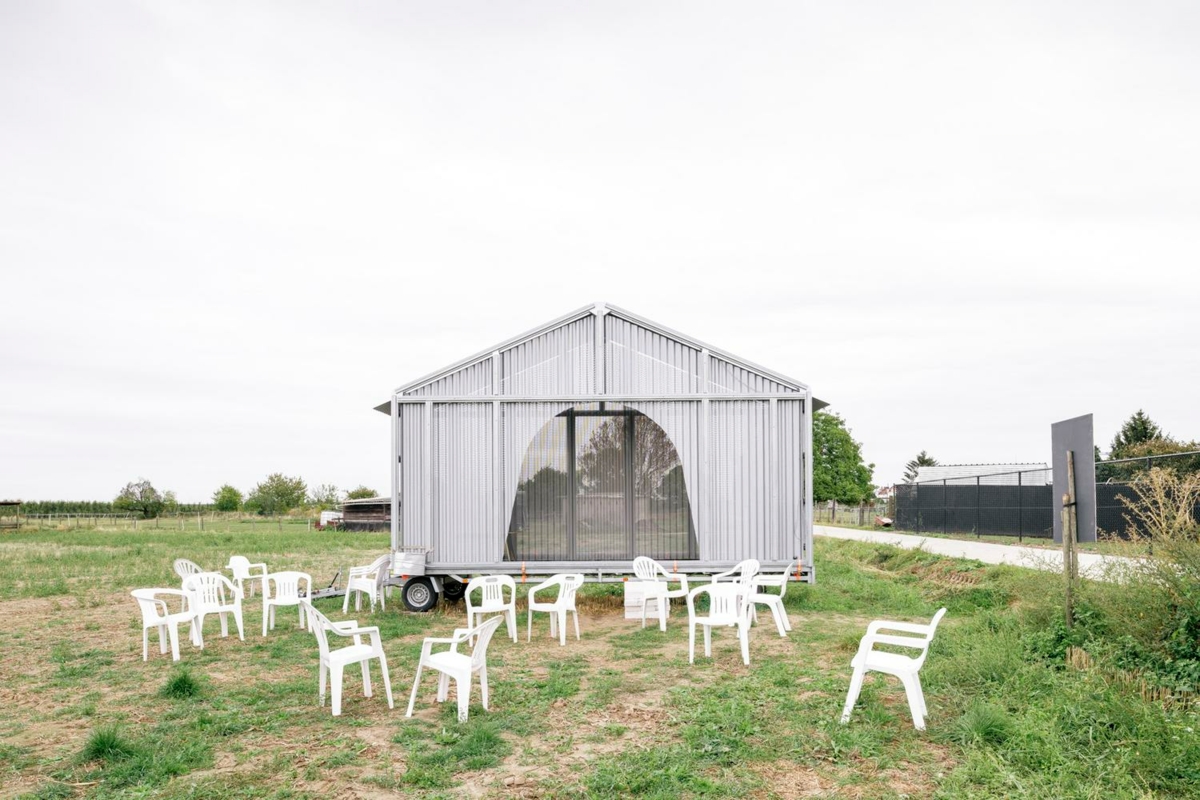
In this self-proclaimed 'public house for private time', temporary and permanent residents were invited to relate to each other in a different way. Not as outsiders, but as temporary neighbours. Seasonal Neighbours appropriated a piece of public space and opened it up to a group that has been part of the rural landscape for decades, but is rarely heard. By doing away with the illusion of the village where everyone knows each other, the roads and the language, a place was created that offers space for otherness. The temporary nature of the House for Seasonal Neighbours, on the edge of a somewhat remote car park, does not bring about structural changes. However, Seasonal Neighbours shows that rural residents are not a homogeneous group and that even groups that are difficult to see, such as seasonal workers, can have a place in the local community. In this way, they redefine the mental space of the countryside, open the door to other projects and raise awareness among local policymakers.
In the spring of 2020, when closed borders threatened to cause a shortage of labour in the fields, Grommen and Royakkers sent out a call for projects to artists, writers, designers and researchers to further explore the theme of 'seasonal work' from a personal work experience in the agricultural sector. The collective now has sixteen members who use their experiences in various agricultural businesses in Belgium, as well as in the Netherlands and Poland, as a starting point. They thematise personal stories of seasonal workers, offer reflections on issues such as automation and empathy with non-human life forms, and explore the hybrid identity of the countryside.
In her project CHŁOPI, artist Karolina Michalik examines rural Polish identity through a centuries-old folkloric tradition: the weaving of a large crown with local grain harvest (Wieniec Dożynkowy). This festive occasion is increasingly motivated by romantic feelings of nostalgia and (religious) patriotism, ignoring modern phenomena such as automation and the high number of Polish seasonal workers in Western Europe. This dichotomy between the reality of the Polish countryside and its rosy representation through the Wieniec Dożynkowy led Michalik to create her own interpretation of such a wreath. To decorate it, Michalik will work at various farms in Flanders in the summer of 2022, together with Polish seasonal workers, with whom she will discuss which materials can represent their experience as seasonal workers. The tools, the plants, the plastic ground cover, everything is eligible.
By appropriating the tradition of weaving a crown and giving it new meaning, important questions arise. Who is this tradition for, who maintains it, and what other forms can it take? Michalik shows that the countryside is not frozen in time. After all, nostalgia, the celebration of stagnation, is also an expression of contemporary sentiment. As a finale, the crown will be presented during De Mooiste Wieniec Dożynkowy, a prestigious competition at the annual presidential harvest festival in Warsaw. Amidst the glorification of a countryside that has long since ceased to exist, her crown will tell a different story. Of the countryside as a hybrid construction, both traditional and hypermodern, local and global, and of the inhabitants who leave to work as seasonal labourers.
Like Martha Balthazar and AR-TUR, Seasonal Neighbours commemorates the mental space of the village and its surroundings. While Balthazar's dramaturgy focuses on polyphony, AR-TUR's establishes important connections between the present and the past of villages. The Seasonal Neighbours collective, in turn, is building a collective dramaturgy around seasonal labour. This diversity of perspectives shows the complexity of the current situation outside the city.
If we consider village dramaturgy as the reading, interpretation and reformulation of the village as text, this could suggest that the village, like a text, is static. However, the three village dramaturgies prove that the village is in a state of continuous transformation. If we read that village carefully, we can even formulate a future for it. Another important shortcoming of the idea of the village as text is that a text gives the illusion of being more or less equally accessible to everyone, whether you read it in Shanghai or on a bench in Loppem. These village dramaturgies, however, arise 'from within'. The artists and researchers live or work for long periods in the specific place in the rural area they want to talk about. Precisely because these village dramaturges become part of the village, they can also change something in it. In this way, new stories about and futures for the village emerge, and the village claims its rightful share in both artistic and social trends.