Plate of Walsoorden
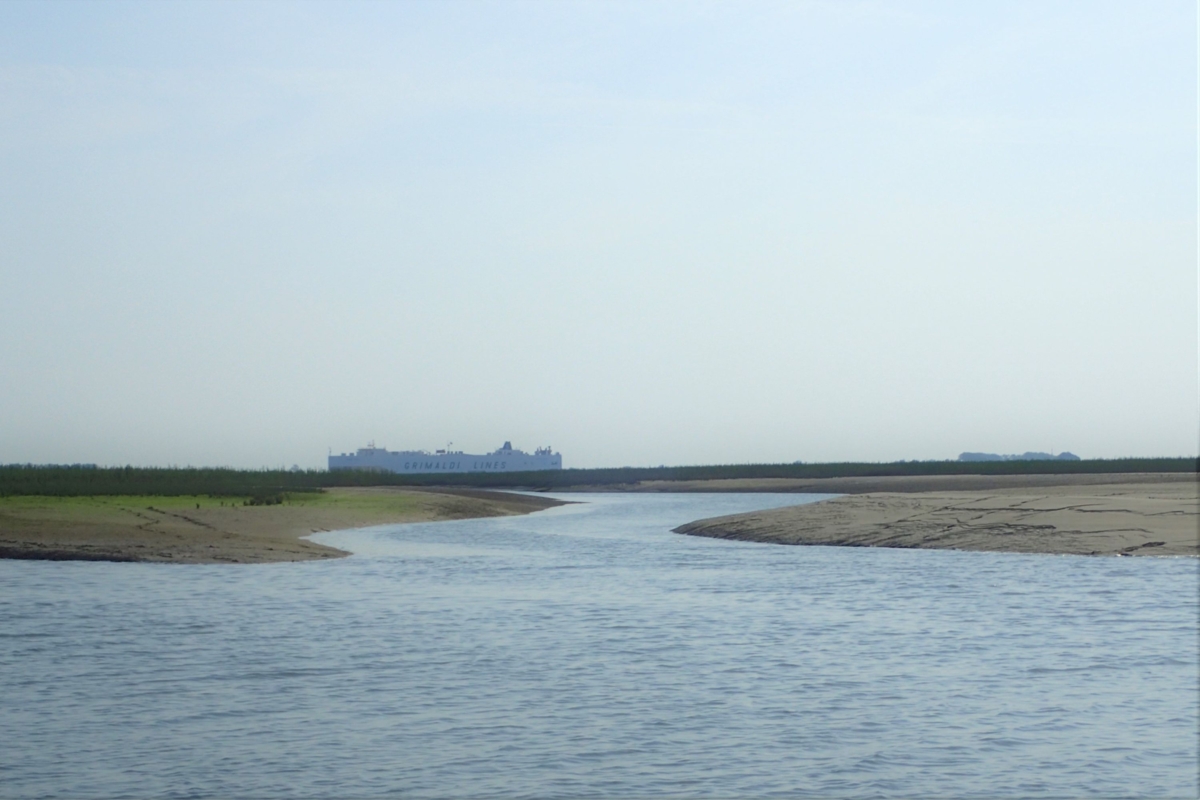
In the middle of the Western Scheldt, between the Zeeland villages of Waarde and Walsoorden, lies an island. At least, sometimes. The island is called the Plaat van Walsoorden and is located in a tidal area where the difference between high and low tide is often more than five metres. Every day, the sandbank undergoes an incredible transformation; at low tide, the salt marshes are several metres above water, and at high tide, they almost disappear beneath the waves. Twice a month, at spring tide, the island disappears completely.
Spring tides occur at full and new moon. Well, a day later, anyway. The sun and moon then pull the water on Earth in one direction, amplifying the tidal wave that moves through the seas. The presence of the moon plays a major role in the development of the Earth. Its gravitational pull causes the tides, but also tempers other, more destructive movements. Without the moon, the Earth would spin much faster on its axis, making severe storms the rule rather than the exception. In addition, the celestial body acts as a shield against meteors because it pulls these wandering rocks 'off course'.
The moon constantly stirs the seas, sometimes blurring the boundary between water and land. This back-and-forth movement of seawater is a factor that should not be underestimated in the emergence of life on Earth. The chemical soup was mixed by the moon and its tides. Lifeless elements hook together in the tidal pools to eventually become life. I don't understand it at all. But that's roughly how it must have happened.
*
"Thirty years ago, there was nothing here!" Jan Poleij told me during my last visit to the sandbank. It was a scorching hot Sunday and he had moored his boat there to stroll around with his son and daughter-in-law. "At low tide, you could fish for plaice here with the water up to your knees, but that was it." Spring tide after spring tide, the sandbank was raised to become the salt marsh area it is today. Just under twenty years ago, Jan Poleij obtained a concession to harvest sea vegetables such as sea lavender and sea purslane. "Back then, it was just a patch of salt marsh measuring, oh, ten acres? Now it's easily sixty hectares."
The rise in sea level would suggest that sooner or later everything will disappear under the water. I asked Guido, my kayak guide on the Westerschelde. "Those salt marshes are something very special. They are very mobile and where they are washed away, for example by a storm surge or something, they simply grow back en masse a little further on. If the water rises, the mudflats grow with it."
*
When I was there at the beginning of August, on the mudflats, a seal suddenly appeared while we were sailing. It looked at us and we looked at it. It was warm and there was not a breath of wind. The water in the kilometre-wide Westerschelde was as smooth as a mirror. The black head appeared and disappeared in a circle of ripples. And just as the animal had come, it suddenly disappeared again, into the depths of the channel. Above it, on the surface, the largest moving structures on earth rumble: oil tankers, car and container ships. They sail to and from the port of Antwerp and their roar and diesel smell can be detected beyond the dykes. The largest ships take the channel south of the sandbank, while inland vessels take the northern channel.
When Guido sees such a ship approaching, he tells us to stop. We float in the middle of the northern channel, with a few kilometres of water in front of and behind us. Guido does not want to risk ending up in front of the bow of such a mammoth vessel. A moment later, the inland vessel sails past. It is a dwarf compared to the tankers, but from a kayak it is still impressive. We wait and remain silent. We are all islands in that still water. I see a cabbage white butterfly fly past and think how remarkable it is to see a cabbage white butterfly flying here, in the middle of the Western Scheldt. Why doesn't the little white butterfly just stay on land? Is there not enough land, perhaps? I would have liked to follow it, because I am travelling at about the same speed as the little creature is flying. However, our course was not the same as his and I lost sight of the butterfly. Will it reach the shore?
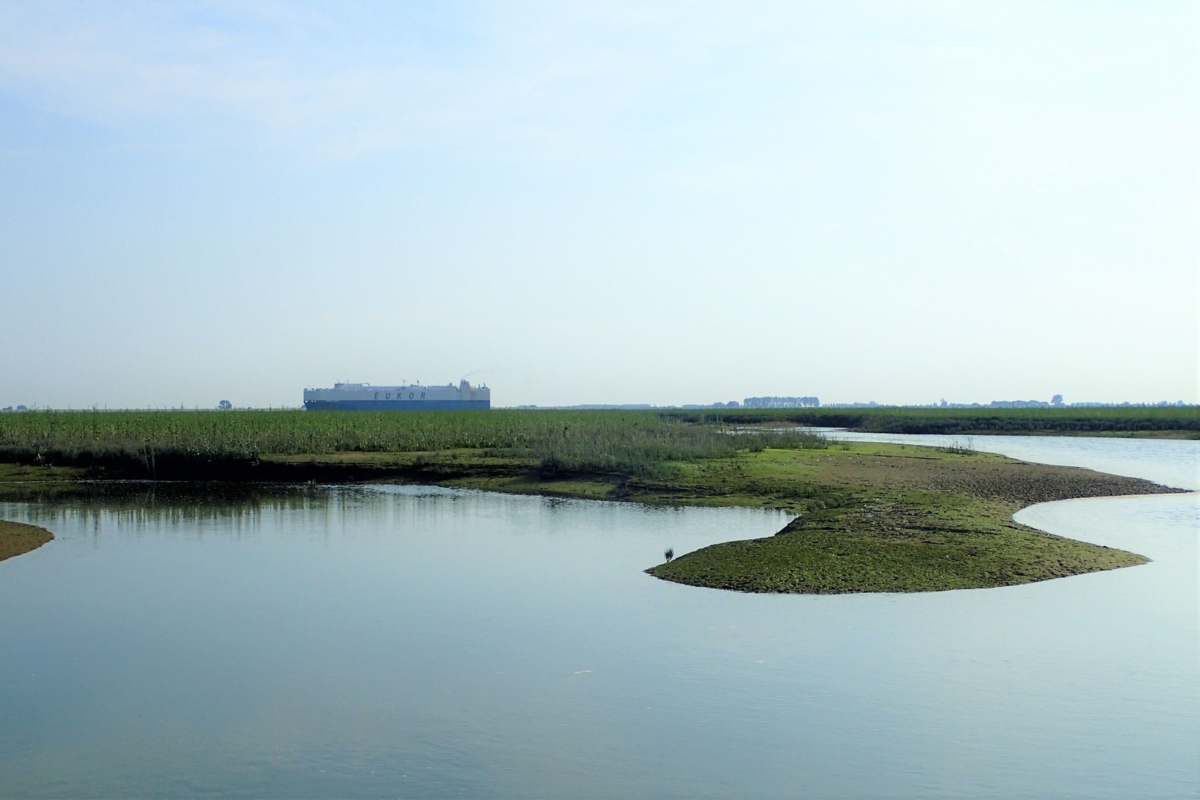
For the first time, I walked across the mudflat from west to east. I walked along the salt marsh cliffs on the north side of the mudflat. Salt marsh cliffs form at the transition between mudflats and salt marshes. The raised layers of silt crumble away under the influence of the waves. I was amazed by the many types of soil that the mudflat contains: mud, sand, rust-red, grey-white, greasy salt marsh clay...
I want to stay here. I want to see how the tide exposes this land and then covers it again. I want to fish for mud in the meandering channels. Count spoonbills and catch the wind. I want to bury myself in the muck, wash myself clean in the brackish water. Eat sea lavender and samphire until I turn green. I want to see a seal and then another. See what washes ashore. See what sails by. Hear the common tern calling. Walk around the island once. Walk around the island again. And again. Dream of water when the spring tide lifts my raft above the salt marsh at night.
This land reminds us of where we come from: swarming earthworms at the beginning of time; crab catchers, peat cutters and sheep farmers on the salt marshes an eternity later; and now captains on long voyages, artists turned civil servants, teachers, sales managers, grief and relationship therapists. The dykes in the distance are higher and stronger than ever before, and the polder fields behind them are full of crops. The water is miles away, patiently swelling until it can reclaim its place.
On the spot, I thought about the reports on climate change and natural disasters and how we are constantly held responsible for them. How, in a relatively short space of time, we are transforming this ancient space rock into an uninhabitable place.
I thought of those old stories of the Flood and of Doré's print: 'Le Déluge'. A small rock protrudes from the waves of a rough sea, surrounded by muscular corpses and drowning people. While a few children watch fearfully from the rock, a handsome father tries to hoist an equally beautiful mother up the cliff. The eldest of the children seems frozen in conflict; what should he do? Should he help his parents out of the water or protect his brothers and sisters from other creatures that have taken refuge on the cliff? At the other end of the rock sits a tiger mother and her cubs. Meanwhile, dozens of seagulls float in the dark stormy sky above them.
*
I always feel that we have to hurry a little here. The tide comes in very quickly and in no time at all the island disappears from under our feet. Our footprints in the mud are being washed away. The kayaks that were lying on dry land just a moment ago are starting to float. The channels are filling up and overflowing their banks, and a moment later even the tall sea lavender disappears under the water of the Scheldt. The island has vanished and we sail back to the little harbour of Waarde. During all my visits to the sandbank, we have always left just as the island disappears. I have only ever seen it disappear, never appear. It always feels like a kind of farewell, as if it were the last time.
I want to stay here so that I can see it for the first time a few times.
Artist Sibran Sampers is working on tidal sidle (noun) - a furtive advance under the influence of tidal forces: a research project in which he records and reflects on his fascination with water (ways). A carefully chosen spot on a riverbank forms the starting point for his stream of consciousness. During this long-term project, he wants to leave temporary traces in various places and work with what is around him.
Read more about the project here.