The research plan: Max Pairon
This interview is part of a series of interviews conducted at the start of PLAN B/Veldwerk, the collective research project on art outside the city by arts platform PLAN B. The interviews offer a glimpse into the practice of the eight participating artists and explore how they are approaching their research project. You can also follow the rest of their journey on this blog. Max Pairon (1988, BE) is a multidisciplinary artist and one of the driving forces behind the social and artistic initiative De Koer in Ghent. Die malle Jan is a research project in which he wants to reflect, together with the people he meets, on how we as contemporary people deal with materials and transport.
Both the start and end points of this project are linked to the same place: De Koer. In this social and artistic workshop in Ghent, I am currently building a workshop together with Leendert Van Accoleyen. When we were thinking about how we could build a floor there, Leendert suddenly came up with the idea of using a tree as a horizontal load-bearing element. That idea has stayed with me ever since. I decided to look for a suitable tree. And I soon started toying with the idea of moving that tree myself. It could be a reason to learn about old customs and share experiences and stories.
I always need a concrete trigger to start a project. From there, I make all kinds of connections. I often return to that one concrete starting point to draw inspiration from it again and again. Perhaps this can be compared to what happens with grafting. Grafting is a way of propagating trees and plants by allowing one species to grow on another. In theory, you could combine an infinite number of species on the same trunk, but in practice, a lot can go wrong. Everything depends on the circumstances. I take the same approach to the various collaborations I enter into. Sometimes it remains a small idea, sometimes it leads to a very close collaboration.
At the moment, I have my eye on a tree in Beerlegem (a borough of Zwalm in East Flanders). It is located on the grounds of Beerlegem Castle, also known as Ten Bieze Castle, where the tree fell during a storm. I wrote a letter to the count and countess in the hope of getting them interested in the project. I would like to be able to stay in the area for a while so that I can carefully prepare the tree on site and look for a method to transport it with the help that may be offered to me.
That silly Jan is a continuation of an earlier work I made together with Wiebe Moerman for the Bâtard Festival in Brussels. In 2017, with GOUDSOEKERS, we moved a large gold nugget from De Beurs to the Beursschouwburg, about a hundred metres away. We wanted to establish a link between the two places: the steps of the Beurs, which became even more of a chaotic grandstand after the introduction of the car-free zone on Anspachlaan, and the Beursschouwburg, which provides a programmed stage, platform and grandstand. In the middle of the city, this simple act literally set something in motion through hard work. The small mass migration that resulted created an interesting energy from the inside out and back in again.
Whereas GOUDSOEKERS took shape in the city thanks to the enthusiastic supporters and passers-by of all kinds during the rolling of that gold nugget, I will be looking for this moment differently during Die malle Jan. I will probably get closer to people's private lives and other details will probably come to the fore. But it is precisely this interaction between the two projects that I am keen to discover, weigh up and play with.
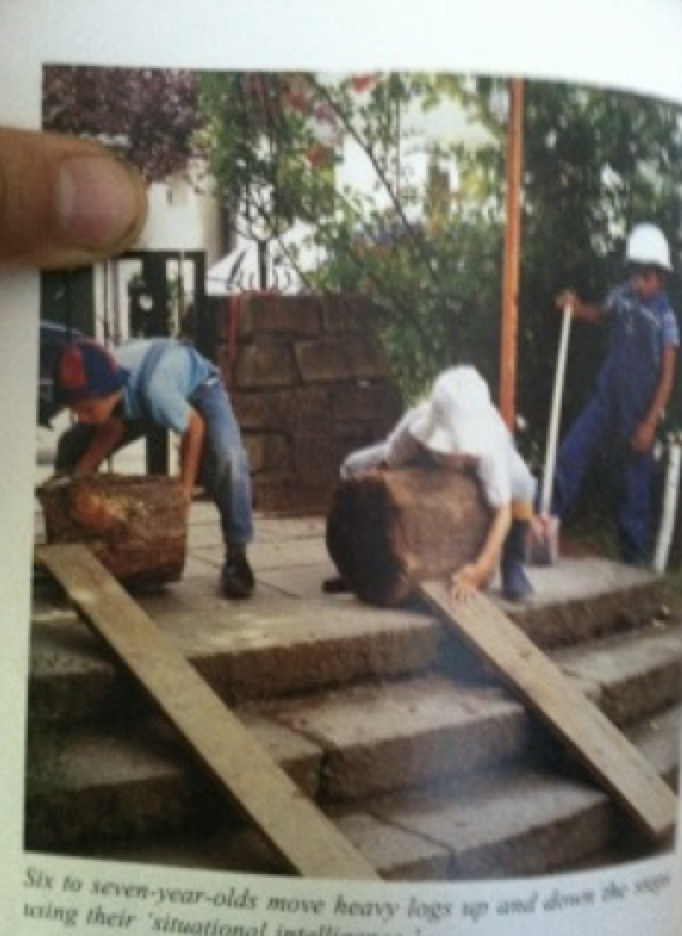
I got this image from a friend of mine, Amy Francescini, after we had a conversation about this project. It is an image she found while rummaging through the private book archive of the Austrian writer, architect and philosopher Rudolf Steiner. The caption under the small photo reads: 'Six to seven-year-olds moving heavy logs up and down the stairs using their situational intelligence'. In it, I see the playful first steps for Die malle Jan. At the same time, it shows an exercise that often recurs in my work.
Read more about Die malle Jan by Max Pairon here.