Expedition Solitaire
1. The Location
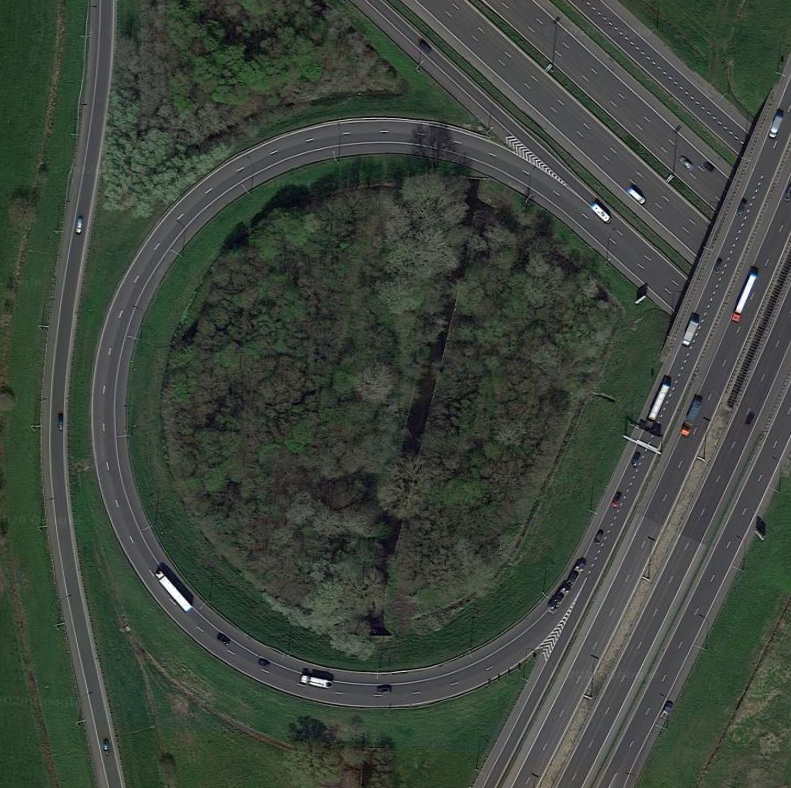
The Bruges junction at the intersection of the Belgian motorways E40 and E403 is located south of Bruges between the villages of Loppem and Oostkamp. The interchange is of the 'cloverleaf' type and was opened to traffic in 1984. The four cloverleafs extend more or less in the direction of the cardinal points. A watercourse called the Lijsterbeek runs through the northern and western parts, flowing into a concrete bed in the western cloverleaf. This canalised watercourse originates in the Doeveren nature reserve north of the Ruddervoorde exit on the E403. The micro-landscapes on the cloverleaf junctions can be described as follows:
1.1. Northern cloverleaf - De Beemd
The northern cloverleaf is located in the bend of the Kortrijk exit (E40 towards Ostend) and is characterised by marshy grassland through which the Lijsterbeek flows. Willow thickets grow on its banks and one large, multi-stemmed poplar tree dominates the view. We describe this landscape as 'de beemd' (the meadow).
1.2. East cloverleaf - De Meers
The bend at the Ostend exit (E403 towards Bruges) is also characterised by grassland and the presence of poplar, white poplar and willow thickets. The mature poplars show a clear planting pattern. This micro-landscape has the typical characteristics of a lake area.
1.3. South cloverleaf - Het Hooiland
The southern cloverleaf in the bend of the Bruges exit (E40 towards Ghent) is flat, wet and only covered with grasses and herbaceous plants. There is no planting or spontaneous growth of trees. Logically, we describe this landscape as hayfield.
1.4. West cloverleaf - The Forest
In the western part of the cloverleaf complex, within the bend of the Ghent exit (E403 towards Kortrijk), there is a forest plot that is cut in half by the Lijsterbeek, which flows through it in a concrete bed. The Forest is characterised by a wide variety of trees and, to a lesser extent, herbaceous plants. The area is almost circular and has a diameter of approximately 120 metres. The expedition described in the chapter below took place in The Forest.
2. Expedition Solitaire to the Forest
On Tuesday 16 June 2020, at around 4.30 a.m., an expedition codenamed Solitaire set off. The only member of the expedition was Sibran Sampers, a 28-year-old artist and civil servant from Alveringem, living in Ghent and Antwerp. Trice Hofkens provided transport for the PLAN B Arts Platform. She dropped Sampers off at the Ghent exit on the E403 towards Kortrijk, after which he climbed over the crash barrier separating Het Bos from the motorway. Once over the crash barrier, he had to descend a slope (covered with umbellifers and grasses) of about 6 metres in height to reach a dry ditch. After crossing the ditch, Sampers reached the edge of the forest. The previous movement, namely the descent of the embankment, the crossing of the ditch and the reaching of the edge of the forest, took place solely by the light of the surrounding street lamps. Other light sources, such as torches, could have betrayed this secret crossing into inaccessible territory.
2.1. Right bank of the Lijsterbeek
Sitting at the edge of Het Bos, Sampers waited for dusk to fall. Shortly after five o'clock, it had become dark enough to enter Het Bos without too much difficulty, and in the semi-darkness Sampers reached the Lijsterbeek, which divides Het Bos into two roughly equal parts. The Lijsterbeek enters the complex from the south via a tunnel under the Ghent exit (E403 towards Kortrijk), runs through Het Bos and under the E40, reappears in De Beemd and, via a tunnel under the Kortrijk exit (E40 towards Ostend), leaves the complex further north. These tunnels connect De Beemd and Het Bos directly with each other, but also with the area outside the complex. This is in contrast to De Meers and Het Hooiland, which can only be reached via footbridges under the E403 from Het Bos or De Beemd.
Upon inspection of the Lijsterbeek, it soon became clear that a thick layer of silt had formed between the sloping concrete bank reinforcement, over which only a small amount of water was moving. An initial assessment near the bank led Sampers to conclude that the layer of mud was too deep to wade through so early in the morning, so he took up position further along the bank to eat an egg cake with butter and smoke a cigarette. In the meantime, he could consider the options for crossing the Lijsterbeek. However, after eating the egg cake and while considering his options, Sampers was surprised by a heavy downpour, which prompted him to spread a plastic sheet on the ground and sleep for a few hours after all.
Meanwhile, the sun rose. In the forest, the songs of countless birds such as blackbirds, chiffchaffs, finches, robins, wrens, willow warblers and great tits echoed. Wood pigeons and magpies flew back and forth, and on the concrete bank of the Lijsterbeek, a lone moorhen foraged for pond snails and other invertebrates. As his logbook shows, Sampers noticed how loudly the songbirds sing in Het Bos and that this increased volume is almost certainly an adaptation to the noise of traffic. "The birds have to sing a little louder to be heard above the roar of the lorries." It takes them a certain amount of extra effort, which is compensated by the safety of this island surrounded by asphalt and traffic. Predators trying to reach Het Bos can do so by crossing the road – at the risk of their own lives – or via the muddy tunnels. Evidence suggests that the latter option is being considered. But more on that later in the report.
The sky behind the treetops was turning bluer and rush hour was getting underway. The diversity of plants and trees in this small area is clearly the result of planting during or shortly after the construction of this interchange in the early 1980s. None of the trees are older than 40 years. They are mainly black poplar, white poplar, oak, beech, hornbeam, alder, white willow, maple, silver birch, elder and rowan. Tall clumps of nettles and ground ivy grow along the stream. Deeper in the forest, the soil is more sparse, with mainly fast-growing maple and young currant bushes. In the Lijsterbeek itself, fine water crowfoot spreads here and there.
When Sampers awoke from his less than refreshing nap, he realised that he is very sensitive to sudden disruptions to his daily routine. Due to circumstances, he had not gone to bed much earlier than usual the night before, even though he had to get up much earlier than usual. As we can gather from his field notes, fatigue and the sudden disruption to his daily routine caused vague stomach problems and persistent worries. He writes:
"I don't feel like building anything. The birds are singing beautifully, but too loudly. The traffic is rumbling. I can feel the vibrations of the lorries under my back as I write this. How long have I been dreaming of an expedition to this place? Two years or so. Now I'm here and it's no use to me. I don't feel like doing anything."
Once again, the explorer seemed to be facing a familiar problem that prevented him from continuing with the planning of the expedition. A vague feeling of unease can be described further in the notes as follows:
"08.46 - When I'm here, my thoughts are there. When I'm there, I'm here. I'm always everywhere, but actually nowhere."
A little later, he writes: "I'm going to cut down a dead tree." After this, the content of the notes changes to more practical descriptions. At that point, he had not yet crossed the Lijsterbeek stream, and the need for a bridge or something similar became apparent. To this end, Sampers took his 'field kit', consisting of a pruning saw, hand axe, pocket knife and sisal rope, out of his sports bag. A little later, he cut down a few dead trees and crossed the muddy Lijsterbeek. He finally reached the western part of Het Bos at around 9:19 a.m. While crossing the stream, Sampers noticed that the mud in the Lijsterbeek was only about 15 centimetres deep and did not pose an insurmountable problem.
2.2. Left bank of the Lijsterbeek
Most of Het Bos is located to the west or on the left bank of the Lijsterbeek. The trees there are taller and Het Bos feels more spacious and mature. In the centre of the western part, a clearing has been created in which a small forest of currant bushes has managed to establish itself. Here and there lie fallen mature poplars and young, straight-trunked oaks. These are remarkable diagonals and potential building material for the 'little building' as Sampers used to describe his project. Towards the exit and the embankment, Het Bos on the left bank is surrounded by dense growth of brambles and hawthorn, which leads to the conclusion that Het Bos is only accessible from the east, i.e. from the E403.
2.2.1. The clearing in Het Bos
The clearing in the western part of Het Bos, mentioned above, has a central growth of small white currant bushes, as evidenced by two hidden white berries. The bare stems also prove that the plants have borne much more fruit, but they also prove the systematic feeding of songbirds. The clearing seemed the ideal location for the construction of a 'little building' and Sampers' eye was soon drawn to a dead, fallen oak tree leaning against a still-living beech tree. Armed with his pruning saw, he set to work on the oak wood, well aware that a trunk diameter of almost thirty centimetres is no easy task when all you have is a pruning saw, which, as the name suggests, is used for pruning. Sampers did not yet know exactly what kind of structure he would use the wood for, but determined to make his day a success and overcome his ailing spirits, he began sawing the oak wood like a man possessed. Fifteen minutes later, the trunk was sawn through, but the tree remained firmly pressed against its base due to its slanted position against the adjacent beech tree and refused to fall. In an attempt to remedy physics with physics, Sampers then constructed a lever to lift the sawn trunk next to its base and thus allow the tree to fall. However, the oak tree did not budge, and on the third attempt, the lever finally broke. Agitated and disappointed, Sampers decided to eat a cheese sandwich, smoke a cigarette and contemplate his sore shoulders against tree X, the maple tree near the Open Spot where Sampers would later set up camp that day during a sudden rain shower.
After the break, Sampers decided to try a different approach and picked up the hand axe to chop down the oak tree. After another 15 minutes of chopping, the trunk finally came loose from the base, but the oak tree was still anchored in the crown of the beech tree next to it. So it couldn't really be considered a 'fallen' tree yet. A subsequent attempt would have consisted of loosening the trunk from the fork of beech branches in which it was wedged. But the acidity in his arms and the blisters on his hands prevented Sampers from making this final attempt.
2.2.1 'Take it easy, man, you crazy fool!
Sweating and nervous, the explorer gave up his attempts to fell the oak tree and in his logbook he advised himself to take it easy and enjoy his time in The Forest. The many fallen trees invited him to climb them, at least those whose bark was rough enough and whose angle of inclination was not too steep. A water linden tree about 30 metres north of the Open Spot was the first to be climbed. The tree was still alive and the small side shoots emerging from the trunk provided grip for the climber. Sampers eventually reached a height of 6 to 7 metres above the ground.
"I used to climb trees, even higher than I did now. Branch by branch, I climbed higher until I was sitting wobbly in the crown, invisible, overlooking everything. I thought of birds and chimpanzees and the nice tingling sensation I felt when the wind moved the crown back and forth. If I was worried about anything, it was the green stains on my clothes. For some reason, I liked climbing trees at family gatherings and other occasions when the children were dressed in their 'best clothes'. A little later, my mother would sigh as she examined the stubborn green stains and wonder aloud how she was going to get them out. However, that question was ritualistic in nature, because she always managed to get them out. Yet she asked it again at every family gathering.
Twenty years have passed and I am climbing trees next to the E40 motorway. It's not as easy as it used to be, and climbing down seems particularly dangerous. Because of the possibility of green stains, I put on dirty clothes this morning, so I don't have to ask myself the question my mother used to ask. But I am all alone here. A branch can easily snap and a 7-metre fall can happen in an instant. What if I break my back here and can't get away? My mobile phone was in my rucksack near tree X when I was climbing the water linden tree. Then I would have been lying there all day. Calling for help is pointless. Trice or Leontien would park on the hard shoulder around 9 o'clock and try to call me. After twenty minutes, they would start to worry. They would convince themselves or each other to jump over the crash barrier and look for me. They would find the clearing by the stream, the path to the bank, the logs in the mud and carefully try to cross. If I hadn't succumbed to something by then, I would hear a branch crack somewhere. I try to shout, like Rose in Titanic. They don't know where it's coming from, searching frantically. Eventually they find me, but a person with a broken back cannot be moved just like that. So the ambulance is called. Maybe the fire brigade too, and yes, the police as well, why not. Blue flashing lights and a whole crowd of people push their way into the increasingly dark forest. I am strapped to a stretcher and carried out of the forest. The six firemen slip on the wet embankment and I fall, breaking my nose as well as my back. I shout, hoarse like Rose, that I am choking on my own blood. Quick, over the crash barrier, into the ambulance and off to Sint-Jan. Meanwhile, Leontien and Trice are being questioned: "What is a 28-year-old man doing alone by the motorway on a stupid Tuesday in June? An expedition? Is he in his right mind? Couldn't he spend his days off better? Egg cakes? Who eats those anymore?" And then, choking on their incomprehension, the officers ask the crucial question: "Art?"
Sampers clearly questions the safety of the undertaking and is aware of the risks involved in a solitary expedition. In the last sentences, however, he also questions the meaning of this project and suggests that it is in fact a form of madness. It is a question that we will not discuss in detail in this report, but which can nevertheless be considered pertinent. The efforts made by explorers such as Magellan, Cook and Armstrong may be considered greater and more risky, but their endeavours did not earn them the epithet 'insane'. Figures who have undertaken similar and eccentric journeys, without emphasising the honour and glory of world nations, and whose mental state is now being questioned, are hermits. At one point, Sampers notes the following in his field notes: '11.07 - To be looked up: what is the name of that saint on his pole? The saint Sampers is referring to is Simeon the Stylite. This 5th-century Syrian left the flocks he was supposed to tend as a boy and joined a monastic order. A few years later, his fellow brothers asked him to leave the monastery because the austerity and severity with which Simeon practised his faith brought shame on the other monks. His form of asceticism was extremely peculiar and he sought ways to transcend the earthly body in solitude in order to come closer to God. He locked himself in a hut for 18 months and survived for many months without food. He was seen standing upright for days on end until he collapsed and lived for a long time in a stone sheepfold on a mountainside. Hounded by large hordes of pilgrims, he left the mountainside to crawl onto a pillar just outside the village of Telanissa (now Taladah in Syria) and never come down again.
According to tradition, Simeon was visited at one point by some desert ascetics who questioned his intentions. After all, Simeon was widely revered, and it seemed to the other ascetics that Simeon was more concerned with the pride of that reverence than with humility towards God. The desert ascetics devised a test of piety, which involved commanding him in the name of God to come down from the pillar. If he did not, they would forcibly remove him from his place. If, on the other hand, he was willing, they would let him remain. Surrounded by a large crowd of pilgrims, the assembled desert fathers ordered Simeon to descend. Stiff but humble, the pillar saint then began his descent, but before he reached the ground, he was stopped by the ascetics. They were convinced and withdrew to their hermitages in the desert.
Sampers mentions explorers, hermits and artists and, ironically, seems to portray the latter as a kind of watered-down version of the former. Can we consider artists to be cowards compared to travellers and hermits such as Vasco Da Gama, Willem van Rubroeck, Simeon the Stylite and Francis of Assisi? In what way can the performances of Beuys and Abramovic, among others, be reconciled with those of the Christian ascetics? Can we replace 'God' with 'Art'? Does the artist share his ego with the traveller? Do artists depict their world, do ascetics approach theirs with faith, and are explorers ultimately not the greatest unbelievers, Thomases who set sail in clippers and caravels to the edge of the world because they want to know rather than believe? Be that as it may, there is a kind of kinship between the artist, the hermit and the explorer, but in a certain sense, being an artist is certainly a lot safer.
2.2.2. The basket and the tunnel
Shortly after noon, Sampers made a new attempt to create something. He gathered a bundle of young maple twigs and tried to weave a basket from the narrow, straight twigs, which he planned to place upside down on a pole in the centre of the Open Space. However, he had never woven a basket before, and the maple twigs turned out not to be the most suitable material for that purpose. After a while, he abandoned the attempt and ate a sandwich with hazelnut spread, followed by a banana. The failed attempt no longer seemed to bother him and a certain calm and clarity descended upon him. Around a quarter past one, Sampers writes that the forest has a calming effect on him. The sun shines through the foliage and casts moving patches of light around them. In the distance, thunder can already be heard. Meanwhile, the traffic raced incessantly around them, which eventually began to have a hypnotic and slightly alienating effect on him. His stomach ache and fatigue were gone, and he had resigned himself to the lack of tools and ideas. His presence in The Forest was enough to call it an expedition.
Early in the morning, Sampers had tried to explore the tunnels through which the Lijsterbeek flows. Because they run under the motorway, he had proceeded with caution so as not to betray his presence to passing drivers. Until recently, there had been a lot of commotion surrounding illegal migrants entering Belgium from northern France via the E40. At truck stops, migrants tried to sneak into lorries in the hope of reaching Great Britain. It was not uncommon to see groups of men travelling along the motorway between Bruges and the French border, with a coat over their shoulders and a plastic bag in their hands. Assuming that the average Flemish person is quite wary of refugees and feels morally obliged to report their presence to the police under the guise of road safety, Sampers preferred to hide in the bushes. There, not far from the water linden tree mentioned above, Sampers noticed the sleeping place of his predecessors: a cleared spot among the maple shoots, an old fire pit, sandwich wrappers and soft drink cans. The expiry date on one of the cans reads: April 2019. Assuming that the shelf life of a can of cola is one year, people slept here during 2018.
"I still have a newspaper article from 2018 with a large photo showing three men in an inflatable two-person canoe. They are on the open sea, with a huge cargo ship in the distance. They are canal boatmen, refugees who bought a rubber dinghy at the Decathlon in Groot-Sinten and are trying to cross the Strait of Dover with it. Sometimes they also set off from Belgian beaches. In that case, it is an incredibly long journey to reach England. It's madness."
About ten metres from the old sleeping place, traffic roars by on the motorway. Once past the screen of elderberry bushes, one has to walk bent over through a dry ditch next to the crash barrier towards the tunnel under the E40. The tunnel itself consists of two rectangular concrete corridors, each measuring approximately 2 by 3 metres and about 114 metres long. At the tunnel, a dam of washed-up wood and organic material blocks the entrance, so that the Lijsterbeek only flows through one of the two tunnels. The bottom of the other tunnel is covered with a thick layer of mud. Once back at tree X, Sampers wrote the following about his visit to the tunnel:
"What a nasty thing. I thought: I'll just go into that tunnel for a moment. Oh my. I had taken off my shoes and left them at the entrance to the tunnel because the mud was about 30 centimetres deep. But after 40 metres (it is really very dark in there and I didn't have a torch with me), the mud became half a metre deep. I was knee-deep in it and I could feel everything. Branches, air bubbles, rough and soft mud. And suddenly, in the dim light at the end of the tunnel, I saw something that looked like a cow's skull, with horns and eye sockets, and I didn't dare look at it. In a flash, the branches between my toes became the ribs and bones of that dead animal. Of course, it wasn't there. But it was there. It gave me cold sweats. If I ever have a corpse to dispose of, I'll dump it here. It's doable, but with a good torch, high rubber boots and company."
Sampers walked through the entire tunnel to the northern cloverleaf, the Beemd. However, due to the daylight and the lack of shoes, he did not venture into the open field. He noticed that the banks of the Lijsterbeek in the Beemd are not reinforced and that herbaceous plants are thriving there. In the mud at the entrance to the tunnel, he noticed the tracks of a fox. The animal uses the Lijsterbeek and the tunnels to cross the motorway. Sampers gathered his courage and retraced his steps, determined to one day plan a full-fledged, albeit nocturnal, expedition to the Beemd via this route.
2.2.3 The fox
The visit to the tunnel proved exciting enough for Sampers to occupy himself with trivialities for the rest of the afternoon. Very little is known about what happened in Het Bos between 2.45 p.m. and 9 p.m., except for a few short notes that are listed here for convenience:
"3 p.m. - Made something with a dovetail joint. Looks good. Something to hang in a tree."
-
"Suddenly had a thought: I could walk around here perfectly naked. Walked around naked for a bit, but then it started raining. Luckily, I had that plastic with me. Made a shelter. Took a little nap."
-
"6:40 p.m. - Wonderful. I was eating my last egg cake when suddenly I heard twigs cracking. It had stopped raining and I looked for the source of the sound. And there he was: a fox! My first mammal friend of the day. He was oblivious to any danger. Looking everywhere for food, sniffing around. He was walking just ten metres away from me. Red, thick tail with a white tip. Almost the cliché of a fox. And I thought of the last time I saw a fox so close. That must have been in the trousers of Handzame, with Chris. There was snow then. 2005?”
-
Another rain shower. Made something small again. A tree trunk balancing on a pole I stuck in the ground. When the wind blows, it wobbles slowly up and down. Now wait.
3. Right bank of the Lijsterbeek - Conclusion
At around 8.30 p.m., Sampers breaks camp and crosses the Lijsterbeek again to get ready for the pick-up at around 9 p.m. By now, the sun has already sunk low on the north-western horizon. Sampers sat down again on the curved elder branch where he had waited for the sunrise some 16 hours earlier. A day in The Forest had come to an end and a little later Leontien Allemeersch and Trice Hofkens picked him up again at the agreed location. Sampers closes the logbook with a final list:
Done: looked, slept, ate, made something and nothing out of branches, wrote, expedition.
Seen: a tunnel, shadows, a fox, panicked robins, lots of dung flies, rush hour, young maple trees.
Thought: will I come back? Can I make something here? Shouldn't I come back to cover my tracks? Does this place need a 'work'? What is the difference between dreaming of an expedition and undertaking an expedition? What am I doing here? Am I an artist? Isn't art just an excuse for crazy behaviour? What is crazy? When is crazy meaningful and therefore no longer just crazy? Isn't there, on a certain level, only craziness? To the place where the refugees slept. To the fox and its path. At the rock-hard oak wood. At Pauline. At how my life is actually structured. At my body. At tobacco smoke. At egg cakes. At my mother. At far too much.
Is it what it is? Or do I have to twist it again to make it something? Why can't something just be what it is? And so good?
Artist Sibran Sampers is working on tidal sidle (noun) - a furtive advance under the influence of tidal forces: a research project in which he records and reflects on his fascination with water (ways). A carefully chosen spot on a riverbank forms the starting point for his stream of consciousness. During this long-term project, he wants to leave temporary traces in various places and work with what is around him.
Read more about the project here.