Interview: Menzo Kircz
This interview was originally written by Vincent Focquet for the publication produced as part of the PLAN B 2018 Arts Festival. The publication can be found here.
Theatre maker Menzo Kircz (born 1989) is graduating this year from the drama programme at KASK School of Arts. In between writing his thesis, he makes time for a conversation about imagination and how we can use it.
Vincent Focquet: What do you feel you have learned during your five years at KASK?
Menzo Kircz: Above all, I have learned to be patient and not to take myself more seriously than my work. During my exchange in Finland, I realised that the way of working at KASK is just one very specific way. That was liberating because I could suddenly listen to myself more. So it's about paying as little attention as possible to those specific expectations and following your own path as much as possible.
What lies ahead for you?
I don't know if I want to continue seeing myself as a theatre maker. But what then? I think it's mainly about continuing to work. For me, the artwork is not so much a goal as a means to an end.
What purpose does the means of art serve for you?
I try to expose the rules that apply to our lives and how we can deal with those rules. It is very important to me that it doesn't stop at exposing existing dynamics. I also want to explore possible futures. I attach great importance to imagination.
What does imagination mean to you?
A negative example is Margaret Thatcher and her 'There is no alternative'. That is a direct attack on the imagination. You always hear people talking about a lack of political imagination. I think that kind of imagination cannot exist without imagination tout court. You have to be able to imagine the world differently before you can change it. Hopefully, my work is an exercise in imagination. After all, in our society, everything is already an image, so you don't have to imagine anything anymore. You just have to remember what you saw before.
What role does that imagination play in your work?
I try to make things that stimulate the viewer's imagination. My work opens itself up, as it were, to a highly associative gaze. That way, you as a viewer can become part of the piece.
What do you mean by the search for a language in the description of Onduidelijke Correspondenties (Unclear Correspondences)?
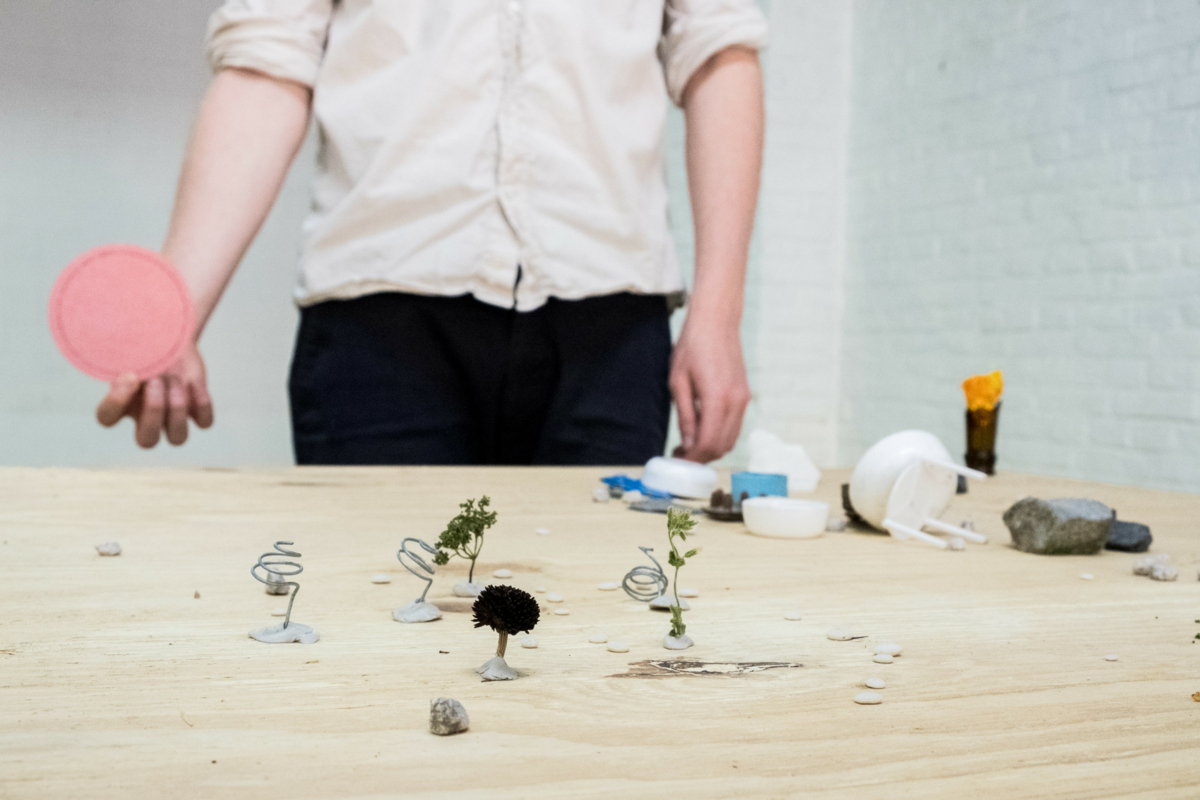
In this performance, I sit at a table with my audience. I have a box full of seemingly insignificant things that I found on the street. I try to convey meaning with these objects. To do this, I appeal to the imagination. This creates a visual language in which the meaning is not yet fixed. It is up to the audience and myself to negotiate what the things mean. Sometimes that meaning is very clear, and we all agree: this is what it means. But many things are less clear, and then the audience can imagine for themselves what the things on the table are.
Onduidelijke Correspondenties also contains language in the sense of text. Where does that come from?
Because I believe the entire piece is about communication, I felt the need for text. Human existence is actually one big miscommunication. We try to understand each other all the time, but we only succeed halfway. For me, the text in the performance is about that. The idea of the correspondence came from Fritzi ten Harmsen van der Beek's beautiful poem Onduidelijke correspondentie en de nadelige gevolgen (Unclear correspondence and its adverse consequences), in two verses. That's what inspired me to start writing letters. That's how the two people (A. and O.) and the attempt at communication between them came about. It shows the limitations of words. The meaning of those words, just like the things in my drawing box, is not fixed. We have to reimagine them over and over again.
Human existence is actually one big miscommunication. We try to understand each other all the time, but we only succeed halfway.
Benjamin Verdonck was your mentor in creating the performance. What did you learn from him? I still
wonder about that myself. What we do is very similar, but it is not the same. What worked well was that Benjamin did not try to make my work more like his. We talked more about what it means to create performances. The two things I learned from him are very obvious, but hearing them at the right moment worked very well. On the one hand, I learned the importance of combining intellectual interest and enthusiasm, and on the other hand, the need for rigour. You shouldn't be too quick to approve your ideas, and it's good to impose rules on yourself, even if you change those rules again the next day.
Onduidelijke Correspondenties exudes an incredible gentleness and care for both things and people. Is that a conscious choice?
I don't think I chose it consciously, but when I noticed that care was suddenly there, I consciously cultivated it. I chose it because the objects I use would normally be described as worthless. They are things like bottle caps, pebbles and dirty papers for rolling cigarettes. I think it's very beautiful to take care of these things together. That's much more difficult than taking care of things you love. But it's actually very important to take care of things that are much more abstract, such as other people or strangers.
Do you do that together with your audience?
Yes, in that sense it is essential that the performance comes about between the people and myself. I don't want to show off my skills as a storyteller. I want us to create something together, to take care of something and to assign value to it. That is very different from me deciding what is valuable. In that case, we are not negotiating. My work contains an implicit reflection on value and the things to which we can assign it.
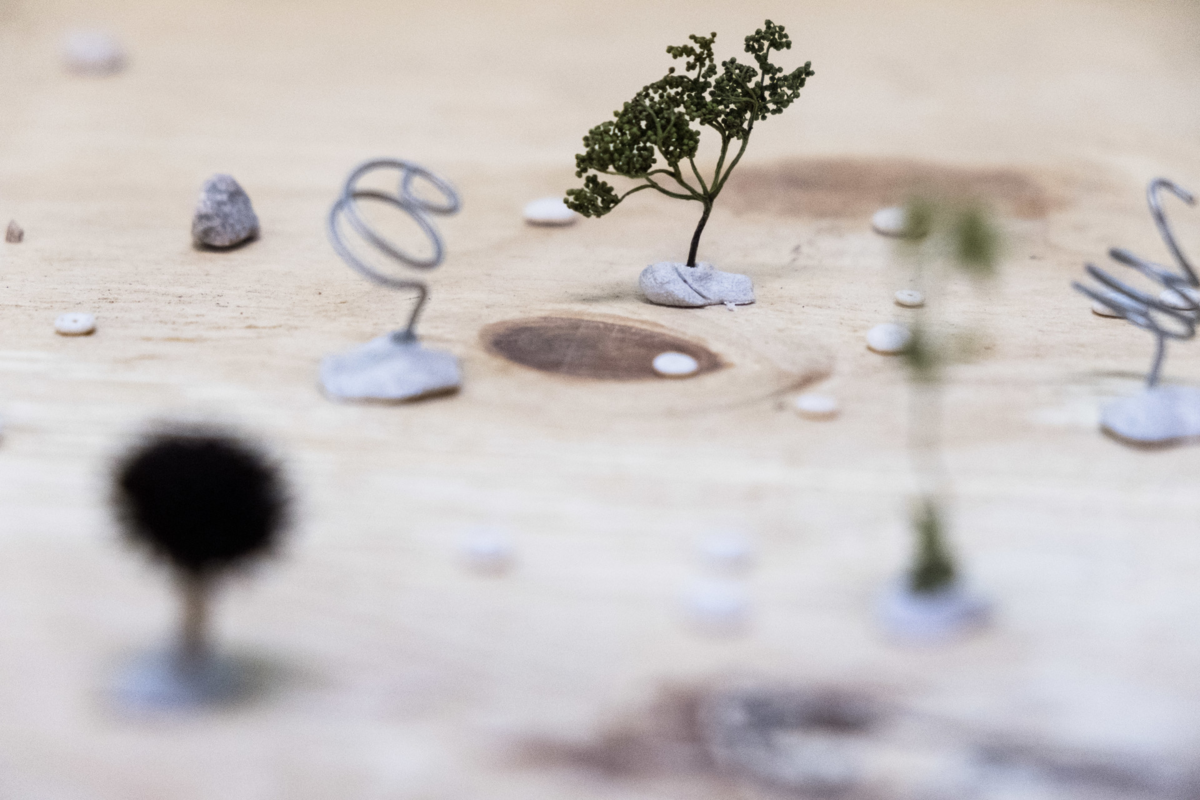
My work implicitly reflects on value and the things we can assign value to.
This naturally brings us to the workshop you will be giving as part of PLAN B. What are you planning to do there?
The idea is to work with people who want to build a scale model of Bekegem using things we find on the street. However, it does not have to be a literal copy of Bekegem. Suppose people think that Bekegem needs not one but two football pitches, then we'll just build two. In this way, we renegotiate what is valuable, now in the concrete context of Bekegem.
The way you address your audience makes your work widely accessible. Why is that important?
I don't want to make art that is only appreciated by people who also make art. Although I am very happy that that kind of art exists. However, I realise that I don't really understand why I would do that. I want to make socially relevant work, not by thematising society, but by placing the work in the world in a certain way. This can refer to both the way the work is created and the way it is displayed. The things I make often come about in a collective way. You can see this very explicitly in the workshops, but it is also important in my other work.
I want to create socially relevant work, not by thematising society, but by placing the work in the world in a certain way.
Does it help to leave the art institutions?
I think so. With Onduidelijke Correspondenties (Unclear Correspondences), I deliberately leave the theatre and perform in cafés and people's homes. I do this because the theatre has become a kind of reserve for the imagination. There is no problem with that reserve, but it does indicate that outside the boundaries of that reserve there is not much room left for imagination. Imagination within the theatre alone is not enough for me. So we have to reclaim that space outside.