Interview: PLAN B on the artistic research project Fieldwork
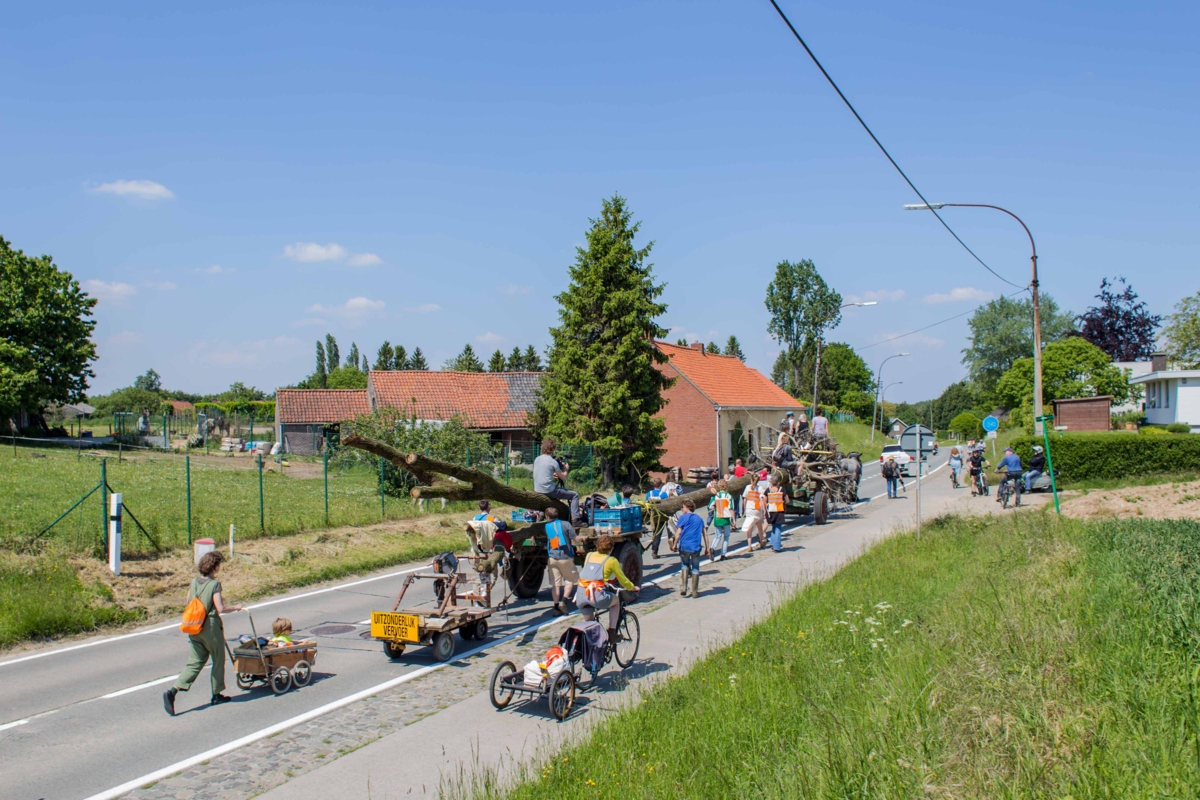
Fieldwork: a rural plan B for artists
How do you make room for rural stories? How do you give artists space and time, even outside the walls of an arts centre? So that they can form relationships with a place of their own choosing. With the residents of a village, with chance passers-by, with a river, a felled tree.
What opportunities are there to create and present work outside the black box or the white walls of a gallery?
Arts platform PLAN B will launch the Veldwerk project, an artistic research platform, in 2021. It brings together promising artists or collectives around current issues in rural areas.
PLAN B is looking for artists who focus their gaze outward. And who literally seek out 'the outdoors'. After the first call for proposals, 147 artists submitted proposals. PLAN B ultimately selected six artists.
How did they make that selection?
We asked Leontien Allemeersch, co-coordinator at PLAN B.
Leontien: "We have a whole list of parameters. It is important that an artist really starts from that rural perspective and does not, for example, suddenly start performing an existing theatre production in a conservatory. We also ensure that we have a diverse selection in terms of people and media. We look at how the proposal fits in with the artist's oeuvre, for example. And they must also be people who dare to be open to other perspectives."
Artist Joris De Rycke is one such person. He responded to the second open call for Veldwerk.
Joris: "Nature, plants and other organisms play an important role in my work. That's why the call appealed to me, and also because it had a lot to do with 'the outdoors'. It wouldn't take place in a building in an urban context."
Small-scale and professional
And that wasn't the only thing that appealed to me. PLAN B also supports the artists in terms of production, finance and communication, without exerting too much control. It is a platform, a refuge, a plan B, outside the institutional stages.
Joris: "Within PLAN B, there is a good balance between professionalism and small scale. It is certainly not commercial, and it is not driven by internal or external politics. There is no 'agenda' behind the choice of artists or themes."
Imagination in a rural context, from festival to platform
2015. Leontien, Jane and Jonathan set up the PLAN B Arts Festival for the first time. In Bekegem, a village of 1,000 inhabitants, between Bruges and Ostend.
Leontien: "When you leave your village as a young art student to go to art school, you inevitably end up in a city. Art production therefore quickly takes place in an urban context."
"But the village (Bekegem) has shaped us to a large extent. And we wondered how we could give something back. How could we work together on something that isn't available here? We invited artists and accommodated them with host families. Together, they embarked on a creative process, from idea to presentation, during the festival."
This is how the PLAN B arts platform came into being and grew into what it is today. The platform works with imagination in that rural context.
Leontien: "We started in Bekegem and are now looking for the rural in the whole of Flanders. And that's not about the countryside. There's too much concrete in the countryside here for that. It's about the non-urban."
Discarded apples and unique plants
Do you ever throw away an apple on the side of the road or along the railway tracks? Who knows, it might now be growing in Joris's orchard. At the Verbeke Foundation.
Joris: "I collect apples along railway lines, motorways or truck stops. In places where people eat an apple and throw the core into the verge. If a seed germinates and grows into a tree, it will be a completely different apple. I now have an orchard at the Verbeke Foundation, where I have collected as many of these 'found apple varieties' as possible and continue to cultivate them. Like a living archive or a living edition."
"For Veldwerk II, I am working on a nature documentary that focuses specifically on plants. Every nature documentary features a wolf, or a fox, or at least a bird in the leading role. But anything smaller than 5 cm receives little attention."
"I chose the atypical landscapes: mining spoil heaps, stone and clay quarries. I am researching the ecology of these places, after or during industrial activity. These are places where you can still find remnants of plants and organisms from millions of years ago among the rocks. And those rocks are responsible for what will grow. It creates opportunities for plants that would not normally occur in that environment."
Fieldwork breaks artists out of their bubble
Fieldwork is also a network. It brings the selected artists together several times a year to exchange ideas and get to know each other's work.
Joris: "There is no clear overlap between the different practices. But we still found each other somewhere. Every month we had a meeting, where we exchanged our thought processes, as fellow sufferers."
"That's how I got to know Daems van Remoortere & Fallow, for example, a collective of architects and artists. They work on saline landscapes and saline agriculture. Last year, I also mapped the banks of the Scheldt for the city of Antwerp. I was working on those saline ecosystems and it was nice to be able to exchange ideas at that moment."
In addition, the PLAN B arts platform also invites other organisations under the banner of the Areaal network.
Leontien: "Areaal consists of AR-TUR, a platform for architecture and space; Manoeuvre, an arts venue for co-creation, craftsmanship and diversity; nadine, a laboratory for contemporary transdisciplinary art; Seasonal Neighbours, a loose arts collective; DEVET, a practice for soft power and radical imagination; and TAAT, a performative-spatial collective."
"We meet three times a year. It's important to have 'sparring partners', and it creates opportunities for artists to move forward. You support the development of a project and bring them into contact with potential partners in an informal way. In this way, we focus on sustainability."
Joris: "If you work in or around nature, seek out organisations that are involved with it every day. Work together. If, as an artist, you want to create work that in some way contributes to biodiversity, for example, their expertise is very welcome. That knowledge also inspires new ways of thinking and working."
"There are many things that seem obvious, but are not. Contact Natuurpunt, the Agency for Nature and Forests, or INBO, the Institute for Nature and Forest Research."
Radically choosing time
During the short creation period of the festival in Bekegem, PLAN B noticed that artists need more time to relate to their environment, to do research. With Veldwerk, which focuses on artistic research without necessarily having to produce anything, they create a framework for this.
Leontien: "We have chosen to let it last a year to a year and a half. Because then you can really do something. Which you can't do in a residency of a week or two. It's a different rhythm. Organisations rarely enter into such a long-term relationship."
PLAN B does this out of care and respect for artistic practices. And for the people they work with, both the artist and the public.
Joris: "Local authorities sometimes ask us to set up a participatory project. They ask you to work with a specific target group and then show something, for example in a display case. For a weekend, and then it's over."
"It would be nice if you could work on something for six to ten years. Only when you are given time can you really work in a process-oriented way."
Nature as a theme
A platform such as PLAN B has a certain responsibility. If you choose certain artists, it means that you endorse their values and their stories.
Leontien: "When we have to decide which projects we will or will not support, we ask ourselves: What story do we want to tell with Veldwerk in relation to society at large? The theme of 'nature' is therefore very important and urgent."
"The luxury of the cultural sector is that you can work with imagination and have free rein in the connections you make. You have no obligations, you can provide a counterpoint."
When you work with nature, you immediately touch on other themes. Leontien gives the example of Die malle Jan, one of the projects within Veldwerk I.
Leontien: "A tree is being moved. But it's also about heritage, about a very social and connecting element. There are several themes that come together."
"Nature weaves itself in between, whether appropriate or not."
Text / Nimfa Tegenbos. Photo © Leontien Allemeersch. This interview originally appeared on the OP/TIL website.