Nature in the margin: about Ruderalia by Joris De Rycke
Nina de Vroome
The nature documentary is a well-known and formulaic genre. Nature is smoothed over and made accessible with glossy images and dramatic music. A bold voice-over provides commentary, but mainly turns everything that happens in the grass, in the treetops or under the clouds into a spectacle. Animals and plants are characters in a compelling story in which the narrative structure usually revolves around the question of whether the main character will eat or be eaten.
Ruderalia is different. It is a 'hardcore' nature documentary. It mercilessly goes to the heart of what nature is, without embellishment. You even get the Latin names of plants thrown at you and the soundtrack consists of experimental music. In the film, we see no cuddly or creepy animals, but banal and even marginal nature. It looks at nature that exists on the margins of motorways, industrial areas and mine pits. Places you would not normally give a second glance. The film is a dive into the real Belgian wilderness, off the beaten track and far away from information boards and signposts. And that turns out to be extremely fascinating.
The title Ruderalia is derived from the word 'ruderal', which refers to environments that have been disturbed, usually by human activity. In Latin, 'ruder' means 'rubble' or 'rubbish'. The film therefore explores these disturbed lands, which are usually not seen as nature, but as wasteland. These are zones without purpose, utility or destination. Why would anyone choose this 'ruderalia' as the subject for a film? The director, Joris De Rycke, is an artist and, in that capacity, works with Belgian nature, which is always a hybrid of natural processes and human activity. Previous projects he has developed provide a history of the origins of Ruderalia.
Joris studied graphic art and transposed the idea of copying an image to grafting apple trees. By grafting, you make a copy of a tree, a second tree with exactly the same DNA. He did this with apple trees that sprouted from discarded cores. What started as waste on the roadside became a curated orchard. In this way, he cultivated new varieties with surprising shapes and flavours. He is also working on the development of a park in Ressegem. His proposal is actually very simple: together with local residents, landscape drawings will be made by mowing the grass with scythes. Wild grasses and flowers will grow on the parts that are not mowed, either blowing in spontaneously or brought in by Joris from nearby roadsides. All these plants will be given a name tag with information about the plant species. Joris De Rycke loves botanical gardens in spring, but especially in winter, when the plants have died and all you see is bare earth with name tags here and there. The tags show what lies hidden beneath the surface, in hibernation, or as a reminder. In addition, every week he guides interested parties through nature reserves, but also along roads and industrial estates to tell them about the plants and animals that live there. Joris De Rycke invites us to look at the most humble nature with genuine interest. During his projects, he acts as a guide, someone who offers the viewer a new way of seeing, in which naming is a way of assigning value to plants and animals, giving them a history and placing them in an ecosystem, a network of stories.
Ruderalia is also a kind of guided walk. At the beginning of the film, Joris says in the voice-over: "We are going to search through the jumble of sites with different functions for places that escape our urge to plan. Post-industrial sites that have not yet been redeveloped. And active and abandoned raw material extraction sites. Ecosystems develop on surfaces that have been created as by-products of industrial activities, improvising with everything we have brought to these areas. This documentary takes walks through such areas.
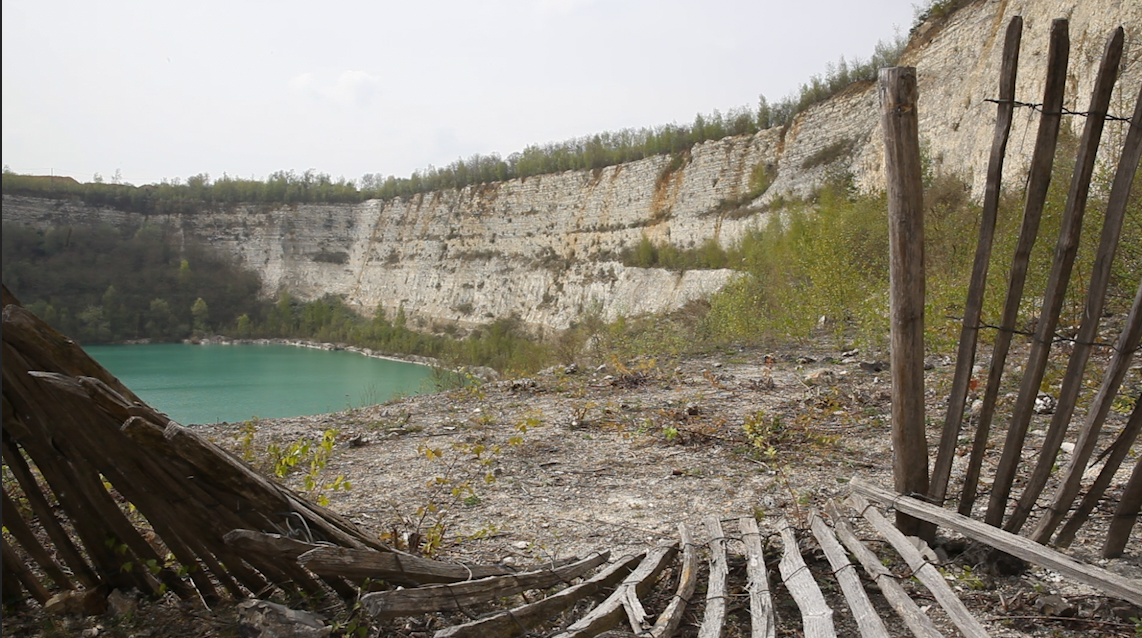
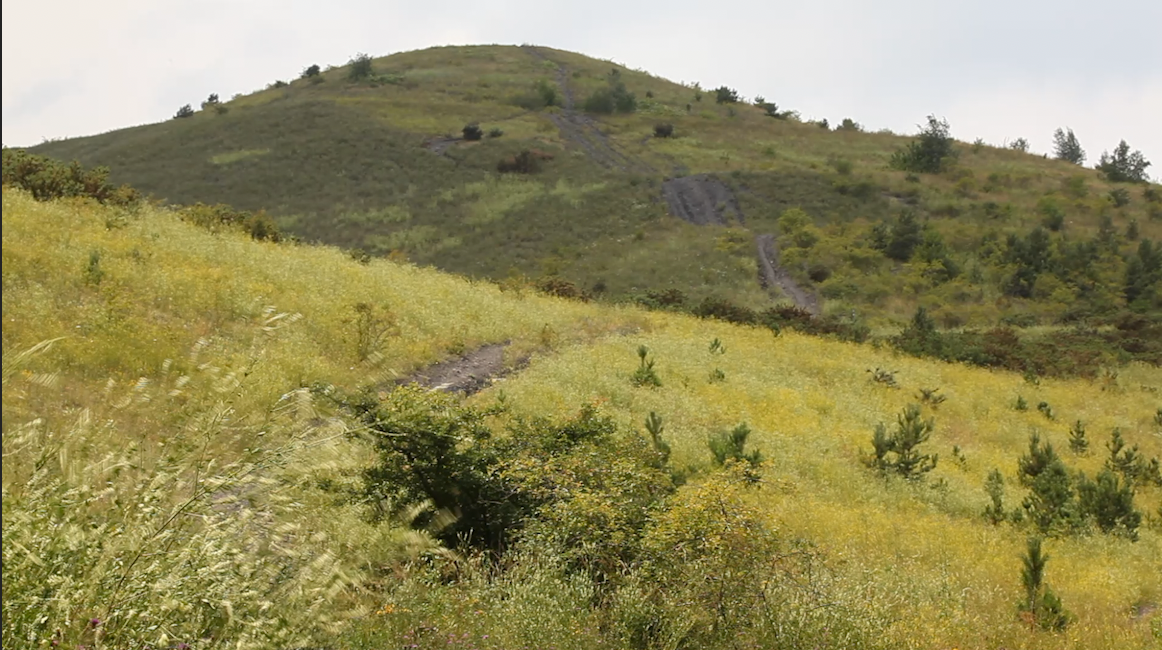
Film stills Ruderalia.
The first stop on this journey takes place in an abandoned sand quarry. We see a pool of water on the bare ground. "Everything starts with water." Close-ups of a stream flowing through a sand bed. There is no sign of life, until the eye catches a green discolouration on some stones. In this sand pit, we are transported back to a time when the earth was still young and the development of life was still uncertain. Science fiction can be that simple: "The invertebrates were the first to crawl ashore. They encountered a world where the simplest algae, mosses, lichens and fungi were bringing the land to life."
The ruderal soils are fresh, but they open a window to a time long before humanity. The walls of a quarry reveal the erratic paths of limestone deposits, remnants of the time when Belgium lay at the bottom of the sea. In other places, the past actually rises up. The slag heaps in Genk, gigantic mountains of low-grade coal waste, contain amazing fossil remains of plants and animals from the Carboniferous period. We see mosses growing on the fossils of the very first trees on earth. In this way, Joris De Rycke contrasts today's flora with that of millions of years ago. If you look very closely, not much seems to have changed since then. Nature is still colonising infertile soil, creating a layer of humus on poor or even toxic soil. This is a process that takes hundreds of years, but is made visible in the film.
Pine trees creak before they break in half. This is why large parts of the Kempen and Limburg regions are covered with this tree species. These dark forests were planted during the industrial revolution for the production of support beams used in coal mines. When the miners heard them creaking, they still had time to flee. The production of conifers has continued, even though mine shafts no longer collapse in Belgium. The past still creaks when we explore this area with our guide. But very recent history has also left striking traces. In the bed of the Vesder, which turned into a monstrous stream in 2021 after heavy rainfall, plants are now growing that once stood on a side table. Seeds of exotic plants that had been buried in the earth for decades have come to the surface and sprouted, such as a hibiscus from Australia.
The guided walk has a very personal touch, because Joris wrote the voice-over and narrated it himself, filmed and edited it on his own, and thus made his first film almost entirely by himself. Joris filmed as an amateur, that is to say, as an enthusiast. After his earlier artistic work, he felt the need to explore his fascination with ecology in greater depth. He wanted to make a film because this medium allows him to focus on the smallest details, but also to zoom out to the bigger picture. He travelled solo with his camera through Belgium and compiled his collection of plants, supported by panoramic views.
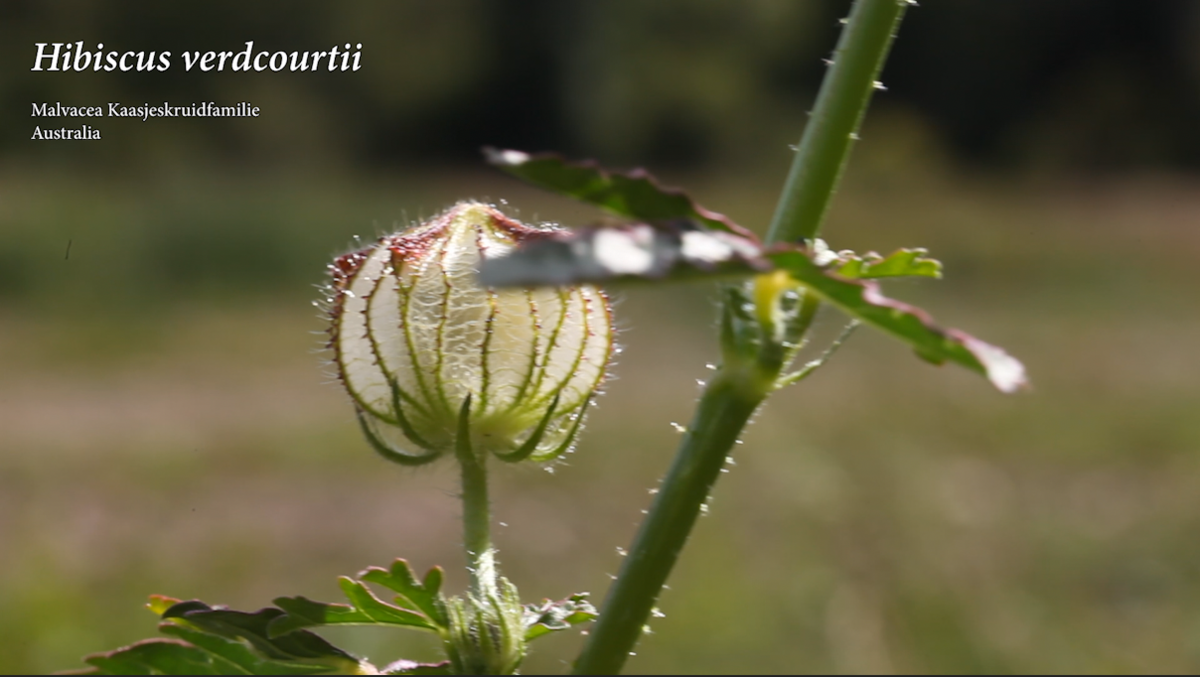
Film still Ruderalia
He only collaborated on the soundtrack. Joris played bass guitar, percussion and guitar, together with musicians Jo Caimo, Jonathan Tetteh, Gerard Herman and Ignace De Bruyn. Each chapter has a different soundtrack, combining jazz and experimental sounds. Joris deliberately chose this sometimes eerie music because he often finds plants and animals strange. The shapes and colours are sometimes psychedelic and seem to come from another planet. The places where he set up his camera therefore seem detached. There is no synchronous sound from the place itself, which makes the film reminiscent of a herbarium. In a herbarium, dried plants are preserved, isolated from their environment and their natural network. In the same way, Joris' close-ups, accompanying Latin names and soundtrack also present a collection of specimens that are immortalised in the film. Nature is not merely recorded, but we are shown excerpts from a mysterious and sometimes ominous world. Ruderalia shows how plants and animals find their niche in the earth that has been disrupted by human activity. They do this in unexpected ways; they rise like zombies from the earth, conquer territory like an advancing army, or have migrated north due to climate change.
The minuscule and the global, the distant past and recent events are legible in the landscape. The plants tell us about the chemical composition of the subsoil, and pollinating insects contribute to the hybridisation of plant species. Joris De Rycke shows that a different kind of nature documentary is possible, one that moves away from sensationalism and delves deeply into the complexity of nature in the Anthropocene.