Notes from Areal II: Radically accessible cultural offerings outside the city
HOSTED BY UITWIJKEN X OUTDOOR LEARNING NETWORK IN ZWANKENDAMME (BRUGES)

Areaal is a learning network focused on artistic practices outside the city. In 2022/23, Areaal will consist of the architecture and space platform AR-TUR, the intermunicipal collaboration GINTER, the art space for co-creation, craftsmanship and diversity Manoeuvre & laboratory for contemporary transdisciplinary art nadine, the loose-fixed art collective Seasonal Neighbours, the practice for soft power and radical imagination DEVET, and the performance-spatial collective TAAT. In addition to the network's core partners, artists participating in the Fieldwork Programme supported by the PLAN B Arts Platform and those interested in the specific theme of the day are invited to participate in the meetings.
Each meeting is organised around a theme chosen by one of the participants in the network. The aim of these meetings is to share practices and experiences with creating and supporting artistic work outside the city with each other and with the affiliated artists. This creates a fabric of shared knowledge about art and/in rural areas and hopefully generates more fertile ground for artistic practices in rural environments.
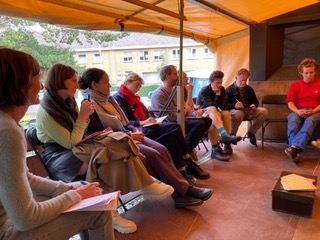
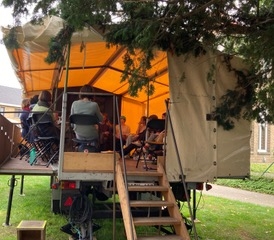
The second Areaal meeting was an exceptional collaboration with the learning network around accessible local cultural offerings in Bruges+: outdoors. On 23 September, both networks gathered in Zwankendamme, where the mobile cultural centre Uitwijken had set up shop in collaboration with the arts platform PLAN B. The focus of both organisations merged into the temporary research question: 'How can we create radically accessible cultural offerings outside the city?' The day was moderated by An Van Den Berghe. In addition to Marec Zeghers and Janes Zeghers from Brugge+, Elien Ronse, an artist from the previous edition of Uitwijken, also joined in. The report below was recorded in his own unique way by Tijs Vastesaeger: not a verbatim report of an afternoon of reflection, but rather good advice in the imperative, fundamental questions and things that just sounded really good.
1. Imperative advice
A lot of concrete tips were provided that can help organisers of outdoor activities. We have reformulated them below in an unapologetically sharp imperative tone.
Meet to meet
If you want to connect with local residents and passers-by, it doesn't help to be busy with lots of practical and/or administrative tasks at the same time. The more you have to do, the less meeting there will be.
Therefore, dare to explicitly instruct employees or volunteers that they do not have to do anything. To be free for unexpected encounters, casual chats, unplanned contacts and connections.
Dig a well. Give people an excuse
A concrete, tangible invitation is often more appealing than a vague pretext. The message 'we're going to dig a well there, would you like to join us?' is more likely to generate engagement than 'you are welcome to attend our performance'. Try to rephrase things into understandable, concrete terms that everyone can imagine.
Give people an excuse, an alibi to (want to) be there. That could also be "that young lad wants to dig a well there, I'm going to help him".
Build on what is already there (said the hairdresser therapist)
For Uitwijken and PLANB, Elien Ronse went to the hairdresser in Sint-Michiels. Hairdressers turn out to be repositories of stories. Customers tell the craziest things to a hairdresser. This makes them both therapists and potential gossip magazines.
You can find hubs of human connections everywhere (including at hairdressers, for example). By taking these as your starting point, you immediately enrol yourself in a broader network of contacts.
Play!
No matter how seriously you take the right to culture, leave room for light-heartedness and playfulness. Involve residents and passers-by in the game. Let them participate in a playful way.
If it is too serious, too heavy, too earnest, it can also be off-putting. However, this does not have to detract from the quality and/or accessibility of the artistic offering.
Take it personally
The contact is between people. If you want people to become personal, to engage, then be personal yourself. Introduce yourself. Call people by name. Make contact. A nice chat can be a greater lever for participation than any mission statement or the name of an artist on a poster.
2. More fundamental questions
In addition to good advice, quite a few questions were asked. Asking yourself the right question, and then asking that question to someone else, is often a good start to an interesting conversation. It was no different in Zwankendamme
Have you asked why they are not coming?
Questioning non-participants, probing for the many good reasons for not participating, is an important learning experience for anyone who organises cultural activities outside the home. This also fits in with the logic of knowing rather than thinking. Asking the question to those who do not come is the only way to really verify whether what you think about the reason for their non-participation is true.
This does not have to be a large-scale survey. The question can just as easily be asked of the passer-by whom you invite to come along but who politely declines the invitation. Dare to ask further questions.
Do you want connection or participation?
Write your own definition of success. When is the project successful: when there are many participants (quantity) or when there is a close connection, collaboration or dialogue (quality)? By determining the objective (success) in advance, you can take more targeted action and make adjustments.
Is this really the task you feel you should be doing here?
Perhaps the context also has its own 'plan'. Is the ambition you are developing in a particular place really what that place needs? Always try to make the best possible assessment of what can work and what offers the right added value. Not every project is suitable for every place. Be empathetic and flexible.
Is that art?
Is that a relevant question?
Perhaps it does not matter at all whether the artistic intervention in public space is understood and seen as something artistic? Does the intervention need to be defined in this way in order to be successful? Or is it sufficient that it brings about something, whatever that may be?
Have you asked the right question to the right creator?
The artist/creator you involve plays a crucial role in the success of your ambitions as an organisation. The artist's attitude and personal drive are at least as important as the artistic quality as such. Not every creator can and/or wants to work and connect in the same way. 'Start with why': discuss the why behind your plans outside the organisation. The how and what can follow from a shared dream.
Why does participatory work so often focus on vulnerable people?
Why can't 'the neighbourhood' be the target group? Why should there be a focus on vulnerable people? Perhaps the participation of the highly educated middle class in a particular neighbourhood is much lower. Why shouldn't they be a priority target group?
Could it be relevant in other ways?
There is rarely only one way to do it 'right'. Dare to let go of a preconceived plan and rethink it in light of what presents itself. Perhaps the context and the neighbourhood need something else? Success is rarely the result of executing a preconceived plan and rolling out a preconceived scenario, but much more often it is the result of responding carefully and intelligently to changing circumstances and opportunities that were not written into the scenario.
Do you want the neighbourhood for your stage or a stage for the neighbourhood?
Be clear. Cultural dissemination is not the same as social-artistic work. Cultural neighbourhood work does not necessarily have to involve co-curation or co-creative processes. It can just as easily consist of selected cultural offerings that are brought to a neighbourhood. What is important is that you create clear expectations. Do not promise participation or shared power if it is not going to happen.
3. Things that sound good
Some words and phrases are too good not to be written down. Below are a few of the most striking quotes.
The dramaturgy of the extension cord
Leaving the safe walls of a cultural centre and heading out into the streets, squares and neighbourhoods brings with it a great deal of uncertainty. Simple things like 'we need an extension cord' can lead to a fascinating search for a practical solution. This quest, this 'ritual', is also an important breeding ground for valuable encounters and connections with the neighbourhood. After all, a clear request for help is the ultimate invitation to connect.
The attitude of the outward-looking space (what is not visible is still tangible)
Culture and art too often take place in outward-facing temples with high thresholds. Cultural neighbourhood work breaks through this. Thinking about the orientation of temporary structures, tents, carts, etc. can help to explicitly orient the temporary space outward as an outstretched hand to the neighbourhood. This will make it more inviting, even without words.
The context will automatically influence the work
Sometimes we do too much – we intervene too much, we steer too hard. Dare to trust in doing nothing. An orchestra that you put on a stage in an open-air neighbourhood will automatically play differently, behave differently than in the large temple with velvet curtains and red plush seats. The context will automatically intervene. You don't necessarily have to add much to that.
Sustainability = transferability
A sustainable intervention is one that can be carried over into the history and stories of a neighbourhood. A ripple that can continue to spread long after the pebble was thrown into the water. Sustainability does not necessarily have to be synonymous with permanence. It may be enough to focus on sharedness and shareability.
The pitfall of the unexplored territory (about colonialism)
Bringing art and culture to 'outlying areas' with 'good intentions' risks turning into a form of proselytising and/or colonialism. An invitation to connect from the awareness that you, as an organisation or artist, are an intruder requires an exercise in moderating enthusiasm and invasiveness. Cultural community work does not have to equate to paternalism. The cultural community worker has as much to 'learn' from the neighbourhood as vice versa.
ORGANISER
buitenshuis
buitenshuis is a two-year project that sets up a new learning network. It originated from existing local cultural projects and the need to get to know each other better. In 2022, buitenshuis will organise three days of reflection and encounters. We will explore philosophical and practical themes and each other, seek ways to realise everyone's right to culture, and exchange experiences. You can call the helpline for advice and practical support. Welcome to buitenshuis.