The research plan: Bert Villa
This interview is part of a series of interviews conducted at the start of PLAN B/Veldwerk, the collective research project on art outside the city by arts platform PLAN B. The interviews offer a glimpse into the practice of the eight participating artists and explore how they approach their research projects. You can also follow the rest of their journey on this blog. The work of architect-artist Bert Villa (1991, BE) always originates from a specific place and the community that inhabits it.
For me, a research process begins with a fascination for and a search for a location that allows for intervention. I like to be guided by a sense of wonder and an honest gut feeling. For example, I am currently toying with the idea of criss-crossing Flanders by bicycle or car and letting myself be surprised by the varied patchwork of woods, meadows and fields, infrastructure and buildings that characterise Flanders. I am increasingly beginning to experience the value of movement within my practice. How do I relate to a specific location? How do I allow my work to be influenced by a new (landscape) context? What dialogues arise between myself and the users of a specific place and how do they propel my process forward? The idea of the 'nomadic artist' began to mature. Guided by a fascination for the places I encounter, I like to start a project by immersing myself in a specific environment. This can be done, for example, by spending a longer period of time at a chosen location (whether or not this includes several nights in the tent I have brought with me).
Due to my studies in architecture, I often catch myself thinking in a very structured way, which I have now embraced. Yet that more instinctive approach remains important to me. By combining structured thinking with the more naive following of my gut feeling, I try to approach my interventions in a very personal way. I can sometimes be very uncertain about a new idea. However, as I begin to physically work and build, and I see how the materials I use gradually change the original environment, that feeling ebbs away. There is something very liberating about working with materials, stopping my thinking, and drifting along on images that arise spontaneously in the moment.
Essentially, I view PLAN B/Fieldwork as a long-term residency in which I allow my creative process to be guided by the landscape, ultimately resulting in a site-specific work constructed in a temporary studio on location. During this process, I am quite drawn to a kind of 'cutting between places'. Our landscape is divided into different types of spaces. There is space for industry on the one hand and space for agriculture on the other, and we reserve space for housing and other places for shopping centres. All these spaces have archetypes: the farmhouse in the residential area with its chimney and fence around the garden, the tanker at the harbour, the windmill in 'the intermediate area', the scarecrow on the horizontal plain of the fields. I find it interesting when the boundaries between such urban and spatial planning overlap and these archetypes begin to intersect; when an interesting disharmony arises between the necessary placement of electricity poles on the quasi-romantic fields, for example. By intermediate places, however, I also mean the places between all these types of landscapes, for example the patches of forest at exits or patches of wild grass around high-voltage pylons. I want to understand the 'soul' of a place and substantive artistic research as two lines that dance around each other and hopefully touch each other at a certain point in my process.
When I start working in a particular place, I find it very exciting to talk to strangers. The starting point for such a conversation is usually a specific question about the history or context of the location in question. Sometimes I seek out people because I need specific materials that I don't have myself. Other times, I search through various channels for the owner of a particular piece of land on which I would like to carry out an intervention. I find it interesting to gather information through a kind of selective oral tradition. Working in a 'strange' location also means that I cannot fall back on my familiar surroundings when I need help, but have to bother passers-by to hold something for me, for example. It can also happen that I consult a local craftsman for help with a job I have no experience with.
I write down the details of the people I meet on notes that I collect in my trouser pocket, after which they all end up in one envelope. This could be considered part of the documentation of my process. At the end of my work process, I also like to invite these people to show them my final result. When you work outside the usual urban context, you realise that you have to work a lot harder to convince people of the value of your work. That is a challenge that also helps me to put things into perspective.
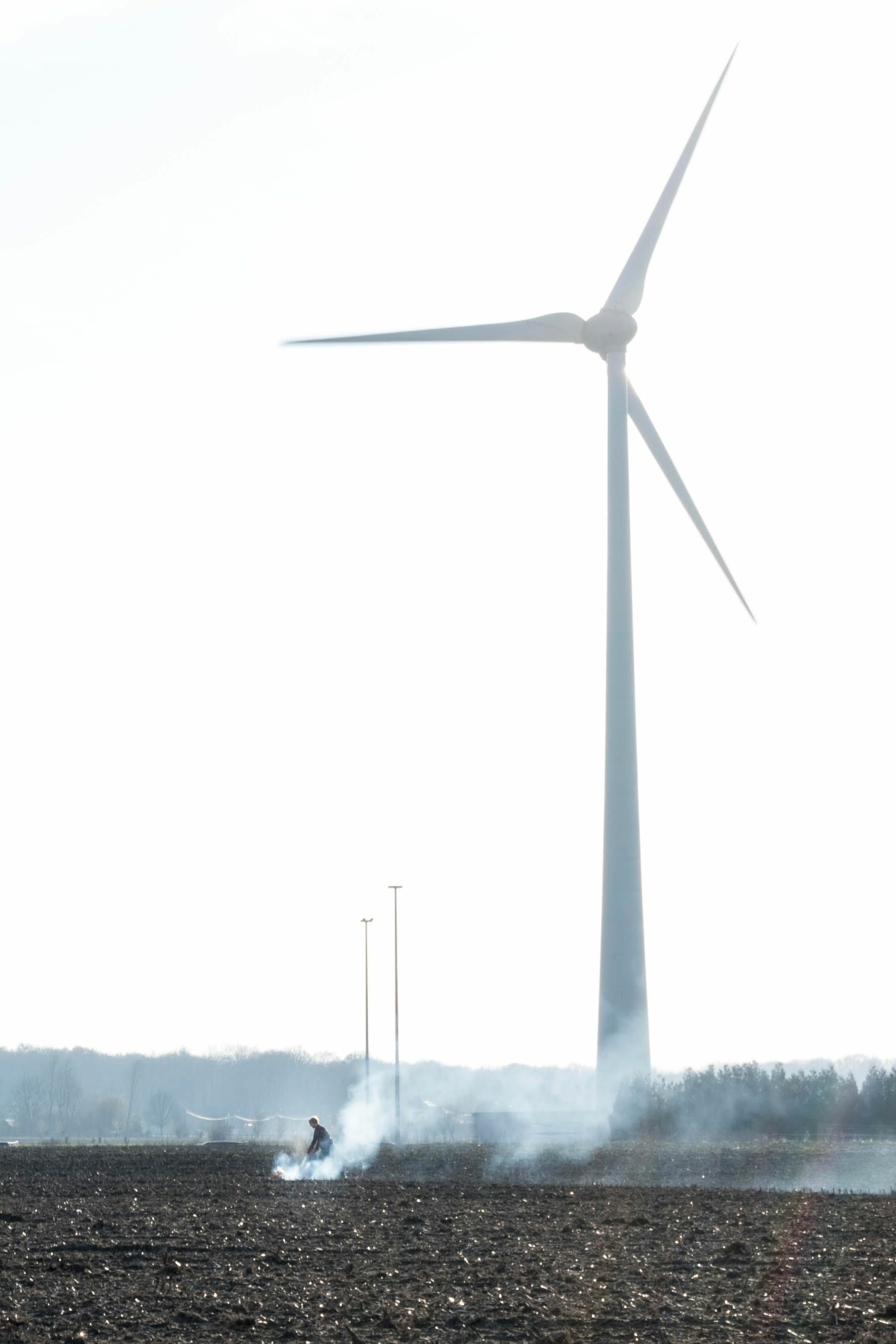
This photo (see above, ed.) was taken when I became fascinated by the phenomenon and history of smoke signals. I wanted to understand how this ancient form of optical telecommunication actually works. So I went in search of the owner of a piece of farmland along the E40 who agreed to let me light a fire on his property, visited the local fire brigade to obtain a permit (which I was ultimately denied, although I did have a nice chat about it), and despite all this, I started burning. In the photo, I am struck by the visual contrast between the action and the gigantic wind turbine. That image has stayed with me ever since and makes me want to continue working on the theme of 'wind as a virtually uncontrollable force that we nevertheless try to harness'. I like to work as a kind of reverse engineer by deconstructing certain forces, techniques or infrastructures, placing them in a historical context and then trying to recreate them through a very personal approach.
Read more about Bert Villa's project here.