The research plan: Ciel Grommen & Maximiliaan Royakkers
This interview is part of a series of interviews conducted at the start of PLAN B/Fieldwork, the collective research project on art outside the city by arts platform PLAN B. The interviews offer a glimpse into the practice of the eight participating artists and explore how they are approaching their research project. You can also follow the rest of their journey on this blog. Ciel Grommen (1989, BE) and Maximiliaan Royakkers (1988, BE) share not only a background in architecture but also the joint research platform Seasonal Neighbours.
Since 2018, we have been working together on Seasonal Neighbours: a long-term research project on seasonal workers. We started with the idea of creating a place for guest workers, a group of people who usually remain invisible to the local population during their temporary stay in Belgium. To this end, we built a 'public house for private time' where they could come together to drink coffee, have a barbecue, watch films and listen to music. We stationed this mobile house next to the Aldi car park in Borgloon. Initially, we planned to return this house to PLAN B/Veldwerk and focus on its interior design. We would travel to the guest workers' home countries and look for the places and activities they miss most during their time in Belgium. Organising activities in public spaces and travelling is not immediately possible due to the current coronavirus crisis, so we had to rethink the original idea. That's when the idea for Communicating Vessels came about.
Communicating Vessels is a continuation of Seasonal Neighbours, with a focus on the relationships between here and there. By approaching the workplace and the home country as two communicating vessels, we want to establish a material communication between both places, without being (able to be) physically present there. Because that too becomes interesting: how can we build something from a distance? And how do we give instructions from Belgium?
The exact form our construction will take has not yet been determined. The construction will initially mark the arrival and departure, but will be less prominent than the house. A kind of station, a mobile bus stop or a satellite would therefore be an ideal structure to build in both places. In any case, it will be a challenge to transport materials across the border. At this point, we have no idea whether a material exchange will succeed or not. If it does not, that too is very indicative of the current situation.
For us, research always starts with direct contact with the migrant workers. To achieve this, we want to spend another week with Communicating Vessels on a farm where migrant workers are employed. Recently, we scoured VDAB websites looking for job vacancies and came into contact with a farm in the Antwerp Kempen, where we can start the project from scratch. In 2018, Ciel visited several farms in Haspengouw, which proved to be the best way to get in touch with migrant workers.
Ciel: I grew up in Borgloon, the fruit-growing region par excellence in Limburg. Although there were many seasonal workers there, I never really came into contact with them. I only became aware of the mini-society in my backyard when my sister married a fruit farmer who employs about eighty people from Eastern Europe during the harvest. While I have always worked in cities where these international collaborations are publicly visible, it only became clear to me later that they had also been present in my native region all along.
Initially, I had a very romantic image of these seasonal pickers: the solidarity, the language that develops in the fields... It was precisely these elements that prompted me to start picking myself and to investigate. Because it is difficult to understand that world as an outsider, it was necessary to become a temporary part of it myself. My first picking season was mentally tough: you find yourself in a harsh working environment and a closed living environment with people of different age groups, nationalities, living situations and vulnerabilities. It immediately shed a different light on my previous assumptions and inspired me to create work around it. I have been working on this for three years now.
Maximiliaan: Within our artistic practices, we have always had a fascination with urban issues within non-urban spaces. It was already clear during our architecture studies that Ciel and I would follow different architectural paths. That is precisely why we always stayed in touch. When Ciel was in residence in Liège, she showed me what she was working on. I was quickly fascinated by how her village told a story that is actually about Europe as a whole. I had never been confronted with what was going on there before, but this theme of seasonal workers immediately captivated me. What we are investigating are urban dynamics that take place in a context that does not physically look like it.
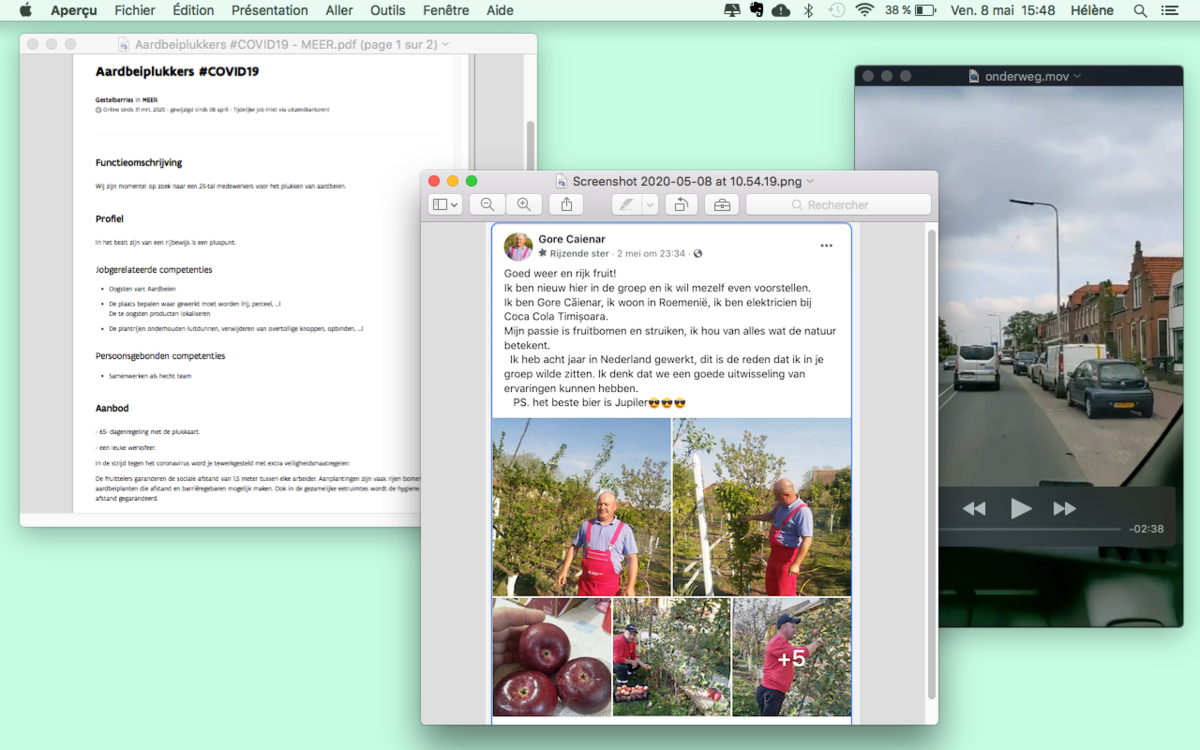
This collage (see above, ed.) shows a screenshot of the specific VDAB job vacancy for the strawberry farm where we hope to be able to pick, supplemented with social media posts from migrant workers. On the right is a video image of a Bulgarian picking friend, who shares her last kilometres through the streets of the Netherlands. In the centre, a Romanian worker introduces himself in a group about fruit growing. We are fascinated by how these different realities and cultures come together thanks to fruit picking.
Read more about Communicating Vessels by Ciel Grommen and Maximiliaan Royakkers here.