The Research Plan: Daems van Remoortere & Fallow
This interview is part of a series of interviews conducted at the start of Fieldwork II. They offer a glimpse into the practice of the six participating artists/collectives and explore how they are approaching their research projects. You can also follow the rest of their journey on this website. Here, Carmen Van Maercke (Fallow) and Lena Daems (Daems van Remoortere) discuss their project 'Archaeology on Salty Soil'.
We started with the idea of salinisation and the associated problems that arise in agriculture and beyond. We are building on the project De Zilte Scheldetuin (The Salty Scheldt Garden), which Lena started a few years ago. For this research, we are focusing specifically on agriculture, where soil salinisation is seen as a threat because the crops currently being grown cannot grow in salty soils. For Archaeology on Saline Soil, we want to take the opposite approach and see how we can turn the inevitable salinisation of our soil to our advantage.
We want to carry out our project in three phases. The first phase consists of marking out a specific area to work on. We will approach the first part mainly from a scientific perspective, taking samples to determine the extent of soil salinisation. We also want to investigate whether it is possible to grow crops in this area. We are currently looking for a piece of land or an area where our research can be carried out. We also want to interview farmers in order to better map and highlight the problem of salinisation. In doing so, we also want to investigate how this is currently being addressed: is salinisation being embraced or combated? So far, we have mostly encountered the latter. The third phase involves creating a section of land where salt-tolerant plants can grow. This practical implementation will take a lot of time.
The idea of allowing salinisation is often difficult to accept. We have noticed that very few farmers or other stakeholders are open to this, because it requires a completely different approach and is most likely irreversible. This somewhat understandable rejection makes it difficult to get started on this project. That is why we have to postpone our concrete plans for the time being and do more research, almost cartographic preparation.
We are now focusing on discussions with people with different views on the salinisation issue. For example, there are umbrella organisations for farmers such as the Flemish Land Agency or the Flemish Environment Agency. There is now also a Dutch-Belgian collaboration around the Scheldt: the Delta Geopark. In this network, the provinces of Zeeuws-Vlaanderen and East Flanders are working together on issues such as salinisation. These umbrella organisations have a good and complex understanding of salinisation, which makes them interesting discussion partners, but ultimately we want to engage in dialogue with farmers in particular.
The idea of an incision in the chosen landscape will ensure that visitors and passers-by can no longer simply walk in. The saline plants we want to grow there will provide different textures and colours that are part of the artistic development. As a second possible outcome of our research, we are considering a small publication in which we will depict the plants, but also create a kind of sample card of the plants we encounter in those areas and the extent to which salinisation can be observed there.
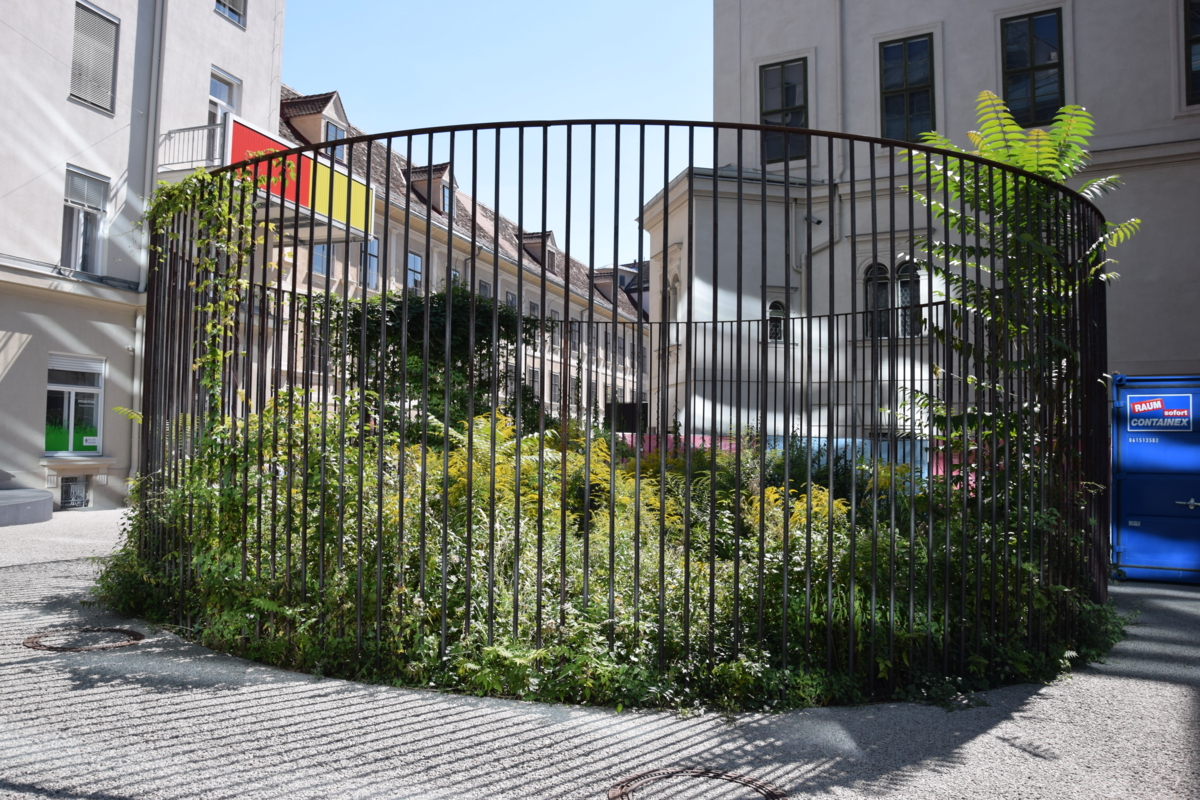
In Wild Cage (2013), Lois Weinberger literally puts nature in a cage. Weinberger was an Austrian artist who collaborated with S.M.A.K. in Ghent on several occasions. He focused on ecology, culture and the influence of humans on nature as subjects. We approach our work in a similar way. We are interested in the tension between nature and humans and between the accessible and the inaccessible.