The Research Plan: Lucas Devolder
This interview is part of a series of interviews conducted at the start of Fieldwork II. They offer a glimpse into the practice of the six participating artists/collectives and explore how they are approaching their research projects. You can also follow the rest of their journey on this website. Here, Lucas Devolder talks about his project 'Gemene gronden gemene honden'(Mean grounds, mean dogs).
During a trip to England as part of my studies, I first came into contact with the concept of 'commons'. We cycled from Dunkirk to London. Along the way, I became fascinated by the typical 'footpaths'. In fact, England has an extensive network of footpaths that are maintained by the community. These are paths that are used and maintained by everyone. Such places are very valuable to the community. In that region, you regularly pass signs indicating that you are entering a 'common' (communal land). I wondered what that meant exactly. It could be a piece of land that can be used by the people in the area, the commoners, and where there are a kind of unwritten laws to ensure that the commoners do not exhaust the area. But actually, anything that everyone has access to without paying can be described as 'common', such as water and air, but knowledge could also be seen as a 'common'.
I have wanted to understand this phenomenon better for a long time. I don't call myself an artist, nor do I feel that I work like an artist, even though it's not entirely clear what that means exactly, because every artist has a completely different methodology. Normally, I am not particularly concerned with analysing how I work and what my practice entails; my focus is on what I want to create. Within Veldwerk, however, I have the opportunity to focus more on the process in my research into the commons.
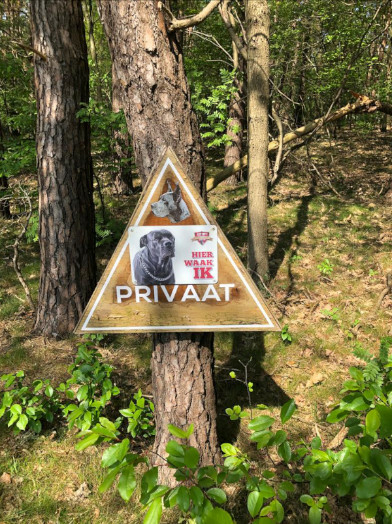
Signs like the one in this photo I took myself stand in stark contrast to the signs indicating common property that fascinated me so much in England. In Flanders, we are not allowed to freely use the water in the ground. Or the airspace or the radio spectrum. These are all things that have now been privatised, something we simply allow to happen. We have no idea what commons are in practice, what they mean, or how to deal with them. As a result, we do not handle things like water or air properly. Even if there are still things, however small, that are truly common, we often do not know how to deal with them.
For years, Ihave been very interested in what I call 'wild space'. This space is created when you let nature take its course. This space may always have been shared and accessible, but wild space can also be reinstalled. Think, for example, of the new rewilding of a city. In these places of rewilding, I believe there is an opportunity to develop commons. But there are also traditional commons that have been around for a long time, such as forests and groundwater.
For me, Veldwerk not only offers an opportunity to better understand commons by reading extensively and engaging in conversation, but in my research I also want to try out very concrete things, and occasionally hit a wall. In the scarce, fragmented landscape that we still have in Belgium, and also to search for what traditions remain. Based on that, I will continue to work on it. In my opinion, commons are a very powerful idea that can offer many solutions to the major and urgent problems in our current society.
Under my logo it says: architect, welder, wild child and idea farmer. Those practical ideas don't grow by working hard on them, but by slowly nurturing them. By going to the library and simply leafing through books, I can harvest them. To make progress, I have to leaf through something related to my research. Then I suddenly see a possible visual translation of something else. From there, an idea can emerge that I can focus on. That idea then flows into a sketch, which I then realise.
Right now, I mainly want to clarify and document my process. Everything we've already talked about, I see transformed into physical objects that appear in a landscape. The question then is how they got there. How did I come to this, how did I make it? Recording this is an important result for me, because it is new in my practice. But the temptation to simply make objects and start adventures again is great. My research into these shared spaces and things will undoubtedly result in a physical intervention.