The research plan: Maite Vanhellemont
My work always stems from a social interest. I am fascinated by worlds that are far removed from my own, such as residential care homes. The first phase of my research involves visiting that social space for an extended period of time. However, I do not see myself as a documentary maker. My work is too distant from its origins for that. Between my documentation of a place and my final work, there are several steps that are not necessarily clear to the viewer. My work does not tell stories with a beginning and an end, but shows fragments that can be interpreted in different ways.
When I start a new research project and go somewhere, I consciously prepare as little as possible. Of course, I do inform myself about the place where I will be staying and the people I will be meeting. Nevertheless, I try to arrive without a clear idea of what I am going to do. I believe this allows the social space itself to shape the research. Moreover, this open attitude ensures that the people with whom I engage in dialogue can profoundly influence my final artistic work.
During the first period of my stay, I document virtually nothing. I record what happens and find out what interests me specifically. We get to know each other first. How do you create a situation of shared trust? That is often a rather exciting part of my journey. Only when that has been achieved do I start filming and taking photographs. That material can then sometimes lie around for months until I know exactly what I want to do with it.
My current research grew out of an encounter with Marijke and Noël, a couple from Bekegem, a village in West Flanders. With our arts platform OUTLINE, I took part in the latest edition of the PLAN B Arts Festival, which took place in Bekegem in 2018. Prior to the festival, we spent two weeks in residence in the village. When asked if Marijke and Noël would be willing to offer us accommodation during this period, they were initially reluctant. It later transpired that this was because they did not immediately feel a connection with the arts and the festival and were unsure what to expect. In the end, they agreed, and that introduction proved so valuable that I now want to go back and explore it further.
In some respects, Marijke and Noël seem very different from me. I live in Amsterdam, a big city in the Netherlands. They live in Bekegem, a Belgian village with about a thousand inhabitants. Our ideas also differ greatly. We will probably never agree on issues such as Black Pete and immigration. Nevertheless, during our stay, we found it possible to engage in dialogue with each other. It took a long time, but we got to know each other and understand each other better and better. Perhaps we even changed a little. For me, this symbolises something broader. Perhaps this movement from distance to closeness shows the possibility of bridging ever-widening social distances.
This is not the first time I have worked in rural areas. It is one of the areas that fascinates me because it is so far removed from my daily life. For me, the fact that your research takes place in rural areas does not necessarily mean that you have to work in a completely different way. In fact, I believe that the differences between the world in the city and the world outside it are smaller than they seem. I want to make as few assumptions as possible in advance, in order to tackle a number of prejudices.
For me, art should be a form of dialogue. I don't believe in the myth of the individual artist who invents everything on their own. In the case of my current research, Marijke and Noël are almost becoming co-authors of my work. Because I will be living with them again for a while and becoming part of their daily routine, the exchange between our worlds will shape my research. In this way, the situation in which I find myself shapes my work as much as I do. Without the place where I am and the people with whom I engage in dialogue, my work does not exist.
This is one of the reasons why it is not enough for me to share my work only in the usual art spaces. Especially since Marijke and Noël will most likely never visit them. In a way, I always want to bring the work back to where it originated, and I am already looking forward to the screening in Bekegem.
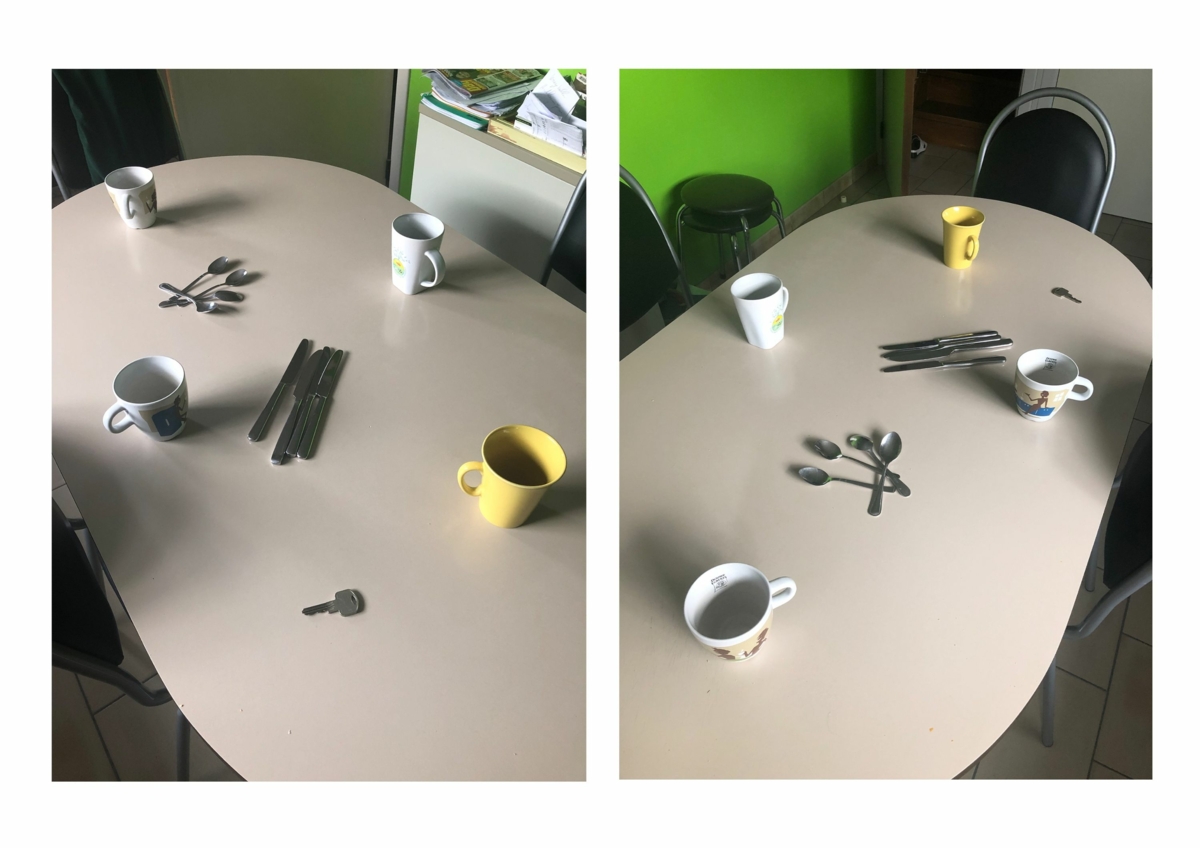
When I think about my ongoing research in images, this photo of Marijke and Noël's table often comes to mind (see above, ed.). It is the kitchen table that Noël set in his own way on the morning of our departure from Bekegem. This image typifies how I see the two Bekegem residents. When I first stayed with them, Noël told me that he was not a 'modern man' because, in his own words, he did not play a role in the household. On the morning we were due to leave, Noël had already left for work, but he had still taken the trouble to set the table. A table set without plates. That's because that's how Marijke and Noël do it: their sandwiches are just laid out on the table, they explained to us. I still interpret that set table as a sign of care, the uniqueness of Marijke and Noël, and as a tiny trace of change brought about by the collision of our two worlds.
Read more about Zoals mij gewoon is by Maite Vanhellemont here.