The research plan: May Abnet
This interview is part of a series of interviews conducted at the start of Fieldwork III. They offer a glimpse into the practice of the participating artists and explore how they approach their research projects. You can also follow the rest of their journey on this website. Speaking here is May Abnet.
My initial attraction to 'the valley' was the resemblance between the way water flows down a valley and erodes it and how information masses spread into networks. As in the case of Mesopotamia, civilisations and written language have historically often sprung up in valleys. Today, the valley is central to the imagination of information technology epicentres such as Silicon Valley. I am interested in how digital technologies shape the world on the one hand and how space and geography are intertwined with social dynamics on the other. They meet each other in the figure of the valley, a place that I keep continuously looking for, questioning and re-imagining in this research.
I have a severe Wikipedia addiction. I am always jumping from hyperlink to hyperlink. Therefore, my research often starts with theory. This time again, I started the year with six months of thesis writing within my Urban Studies programme with my friend Camille. In that joint thesis, we researched how digital spaces and technologies influence day-to-day life: how you eat, sleep, relate or feel... How does this phone in my pocket connecting me to so many other spaces affect my walking on this street?
Now that this thesis is finished, I will start a practice that I imagine as the shadow side of that research. I want to escape the walls of academia by creating knowledge through interacting with people on a more personal or emotional level. Writing the thesis actually confirmed this necessity: as we merged our brains together thinking about humans and machines, Camille and I developed a beautiful emotional connection. Using the valley as a lens, I’m zooming in specifically at the intersection between technology (tools), language (data/code) and space. As a methodology to reflect on that, I dream of creating some sort of peer-to-peer chain with people close to me, because that’s how digital communities function too. We would create analogue or digital tools, which would circle around through a specific system of contributions. That way, we imagine a different kind of valley: one that embraces technology but isn't monopolistic or hypercapitalist, but shared and open source. If a valley is a depression in a landscape, I picture us zigzagging down a river between productivity peaks and platforms of rationality.
I like thinking through images and text, mapping or remixing visual representations, scientific infographics, Internet images, lyrics... I want to keep this research as open-ended as my notion of the valley itself: geological, digital, and imaginary places. I want to embrace this multiplicity and see where it could take us. The materials that resulted from the co-creative chain will be woven into a subjective essay. It could take many forms, such as a publication combined with an audio document or something digital, that reports on the tools we developed together.
I look at the rural through this hybrid concept of the valley. Looking for an actual valley somewhere in Belgium might seem like the obvious first step. But I don't think that's my plan. Since I'm thinking of a digital rural, it's difficult to actually land anywhere because physical and digital space are quite entangled. We are constantly navigating on and off platforms, connecting us to faraway places. The globalised Digital Age has reshaped borders, cancelled distances between people and blurred the distinction between the rural and the urban. I find myself looking at landscapes from satellite vision, zooming in and out on the earth ball. There is a question of perspective: the digital offers a totally different kind of knowledge about places you have never been to physically. I am also interested in how language and code shape the 'rural' as well. Turning a space into a place by naming it is a way to possess it. That is what cartography and other technologies for conquest did originally. And the 'rural' today is very much shaped by information technology. For example, by big data centres that are planted in the countryside or digitalised farming.
Through exploring different kinds of valleys, a very unorthodox imagination about the rural comes into being, as a space that is not backwards but highly technological, virtual or even fantasised. I am currently questioning how I should approach the valley. Should I find a physical one to host a collective tool-making? How extended can a valley be? A specific location? Should I stay at a bird's-eye view? Satellite view? Mind view? More and more, I think this confusion is part of how I want to work and the topics I am researching.
The valley is also a mental landscape of comfort to me. Recently, I found a 1969 newspaper article depicting my grandfather with the title ‘Valley Man Pursues Ancient Profession’ under a photo where he appears as the ultimate craftsman with a beard and holding a ceramic pot in his big hands. He was a ceramist living in a lush valley in Minnesota in the United States. This so-called ‘simple life’ of a hyper-specialised craft in a rural environment couldn’t feel more different from my fast, multitasking, scattered life in a globalised Brussels. From spending time at my grandparents’ wooden house in the past, this environment became a sort of mental refuge I am able to access. This emotional side is also an important aspect of the valley I want to take along in my research.
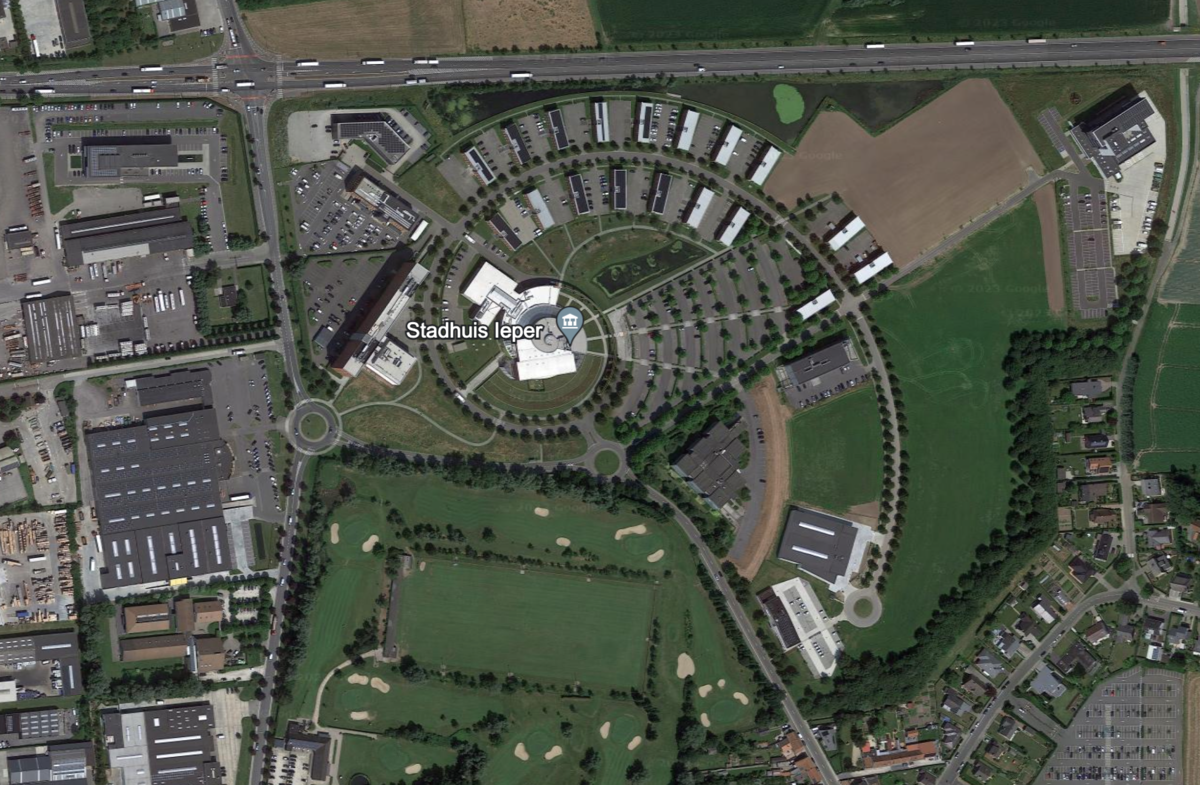
This is an image of a site in Ypres, Flanders, that was designed as a ‘Flemish Language Valley’. As far as I know, it’s a rather flat landscape where the Belgian speech technology company Lernout & Hauspie built their headquarters in the middle of a field in 1999. The site should have become the Belgian version of Silicon Valley, centred around speech technology and translation software. Two years later, the company went bankrupt, and the valley is now a ghost town. It is a legendary failed attempt at top-down planning: as if you can just create a technological cluster in the middle of West Flanders. I find it interesting that it embodies the image of the technological valley, but in a way that is quite specific to Belgium. A great example of how digital technologies shape physical space. Also, it’s telling that the design of the site, shaped like an auricle, looks like it’s made to be seen from above, like the perspective you get from Google Maps.