The research plan: Pim Cornelussen
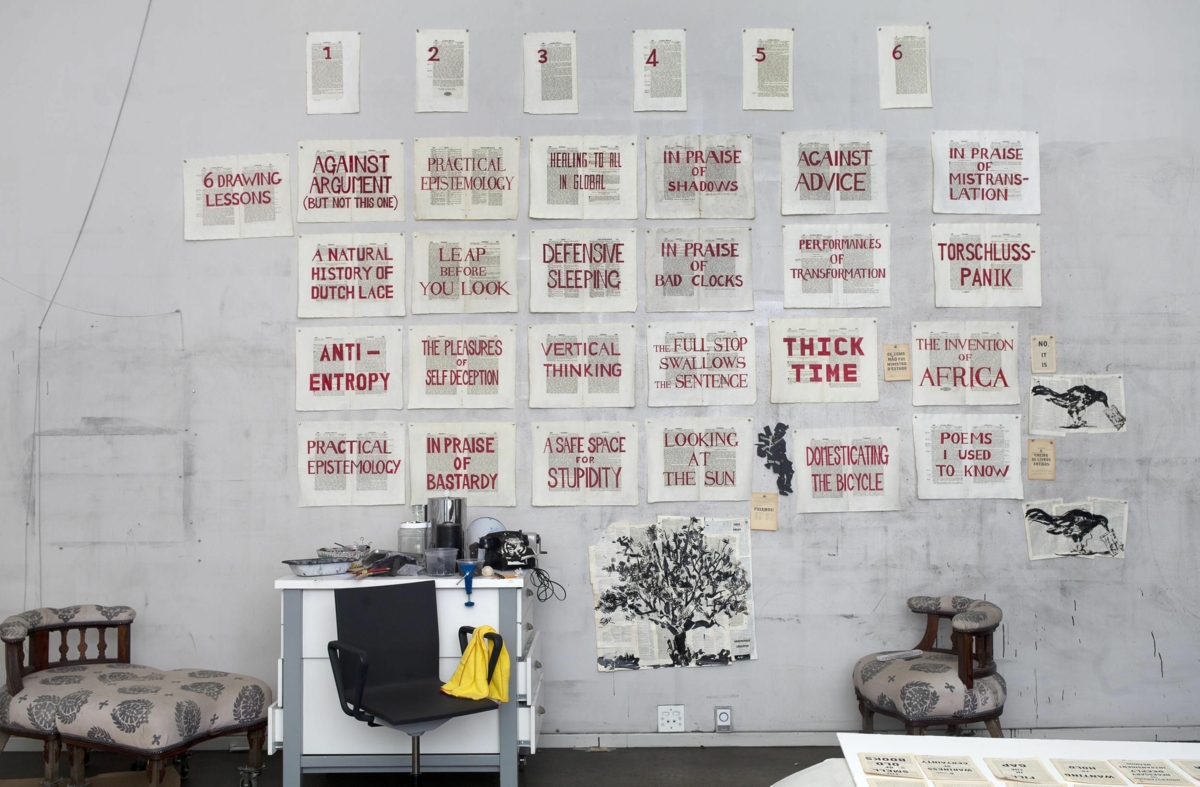
To make these two movements, I always start from a form. That form can be a text, but also a game. When I then begin a literature study, that form helps me to connect all those big concepts. In this way, I guard against my tendency to think in overly abstract and woolly terms. Once I have extracted the most important terms or concepts from my literature study, I begin my attempt to zoom in. How can these ideas be experienced? To achieve this, I devise exercises for an imaginary spectator. These exercises create a kind of phantom experience, enabling the spectator to imagine something, to experience something that is not there.
Before I started this research project, I became fascinated by the phenomenon of intergenerational memory loss. In short, we speak of intergenerational memory loss when a generation has no notion of certain circumstances in which previous generations lived. I am now exploring how we, as a generation, have no memories of the ecological conditions in which previous generations lived. As a result, we are in danger of forgetting what the landscape of our grandparents looked like, but also how a landscape is constantly changing. This is particularly important today because we are living in the sixth wave of extinction. Human activity is causing the sixth mass extinction of organisms on this planet. In this specific context, it is important to make intergenerational memory loss tangible and perhaps even create a kind of memory of what came before us.
I am an avid walker myself. During my walks, I noticed that my surroundings were becoming increasingly monotonous and I found it increasingly difficult to immerse myself in them. Based on this observation, combined with the question of intergenerational memory loss, I came up with the idea of creating walks in which spectators can get to know extinct animal species intimately through an audio guide. I am already working on a walk in Brussels in which the spectator is introduced to the aurochs, an ancestor of the cow whose extinction in 1627 was the first recorded by humans. The spectator starts in the city and is asked to imagine that city away. From that first exercise, a walk with an audio guide begins in ten movements that guide the spectator out of the city and bring her closer and closer to an extinct animal species and the memory of it.
During PLAN B/Fieldwork, I focus on the twilight zone between the city and the countryside. During the walk, the viewer sees the city gradually give way to more emptiness. The movement from densely built-up roads and an obvious human presence to a more open landscape is an important dramaturgical principle for me. That open landscape is important because it allows the viewer to imagine how, for example, the aurochs and humans could live side by side. In the city, such a thing is almost impossible.
The fascinating approach to landscapes by Danish artist Nana Francisca Schottländer inspired me for this research. She often works from the idea of expanded landscapes. In this way, she approaches landscapes not simply as what is given at that moment, but as containing all their former forms and histories. The history of a place is therefore part of that place. That same idea feeds my walks. During my current research, however, I have not only been influenced by artists. Equally important was the work of philosophers such as Rosi Braidotti: an Italian-Australian philosopher who teaches at Utrecht University and publishes on feminism and posthumanism.
Before I started this research, I created an image bank with random images together with theatre maker Salomé Mooij. The self-imposed task was to create a logic in that randomness that was related to our research. One of the images I selected at the time was this museum card. In the image (see above, ed.), you can see a number of versions of Kentridge's work Red Rubrics (2013) hanging above his table. At this stage of my research, it served as a kind of guide. The image is not so much connected to the content of the research, but it did become a kind of talisman for the way I want to conduct it. Over the past three weeks, I worked towards the moment when I could concretise the ten movements of the walk in the same way and place them side by side.
Read more about A Kind of Silence by Pim Cornelussen here.