The research plan: Sibran Sampers
This interview is part of a series of interviews conducted at the start of PLAN B/Veldwerk, the collective research project on art outside the city by arts platform PLAN B. The interviews offer a glimpse into the practice of the eight participating artists and explore the way in which they approach their research project. You can also follow the rest of their journey on this blog. Sibran Sampers (1991, BE) is a visual and performance artist. In tidal sidle (noun) - a furtive advance under the influence of tidal forces: he seeks out hidden, forgotten and difficult-to-access places in order to fabricate an intervention there with whatever is available.
A typical day of fieldwork in the research process for my new project tidal sidle (noun) - a furtive advance under the influence of tidal forces: looks something like this: with just a knapsack containing a saw, an axe and some provisions, I set off on what I like to call an expedition. I call it an 'expedition' because the locations I travel to are often 'lost' places, hidden patches of greenery between railways, motorways or port areas. They require real effort to be discovered. Once on location, I get to work with simple materials that I find on the spot, such as tree trunks and dead pieces of wood. I sort the materials and then start building without a specific goal in mind. The final installations are sometimes recognisable – a hut, a bridge – and sometimes more abstract. There is a simplicity in the installations that contrasts with my earlier artistic practice. Back then, my approach was much more conceptual. Now I try a much more naive, playful approach that allows me to avoid difficulties such as high costs, transport and lack of materials. I let myself be surprised by the tools available on site. That is enormously liberating.
Working in rural areas has always appealed to me and has been part of my practice on several occasions. For example, I organised an exhibition in the church of Oeren, a virtually uninhabited village near Alveringem, the place where I grew up. I lived in that church for a month and exhibited my work there to interested passers-by. In that respect, I am fascinated by the working methods of classic Land Art artists such as Richard Long and Andy Goldsworthy from the 1960s and 1970s. Their minimalist approach to materials, which can always be found in nature, and their immediate intervention in the environment, prove to be very inspiring for my own practice. Creating artistic work outside the city also has an important financial aspect. I feel that when you are completely financially dependent on your art practice to survive, you are automatically pushed into a more urban context. Now that this is no longer the case for me, I can work in a much more selective, spontaneous and slower way. The fact that I no longer have to experiment within the four walls of my studio, but can seek out rural atmospheres, is very motivating. I try to incorporate
these pioneering experiences into the documentation of my work, which, in the form of photographs, text, diary excerpts or drawings, constitutes a reflection or conclusion rather than an illustration of the different layers in the work process. This documentation may be intended for a wider audience, just as the photographs of Richard Long's A Line Made by Walking (1967), for example, are better known than the work in situ. To experience the aura of the work, you actually have to go on an 'expedition' yourself. Mapping out my chosen locations may be a start; a way of drawing attention to forgotten places; of making people look differently at their familiar and therefore often seemingly banal surroundings. Whether I will work towards a concrete and final product, accompanied by a classic public presentation, remains to be seen.
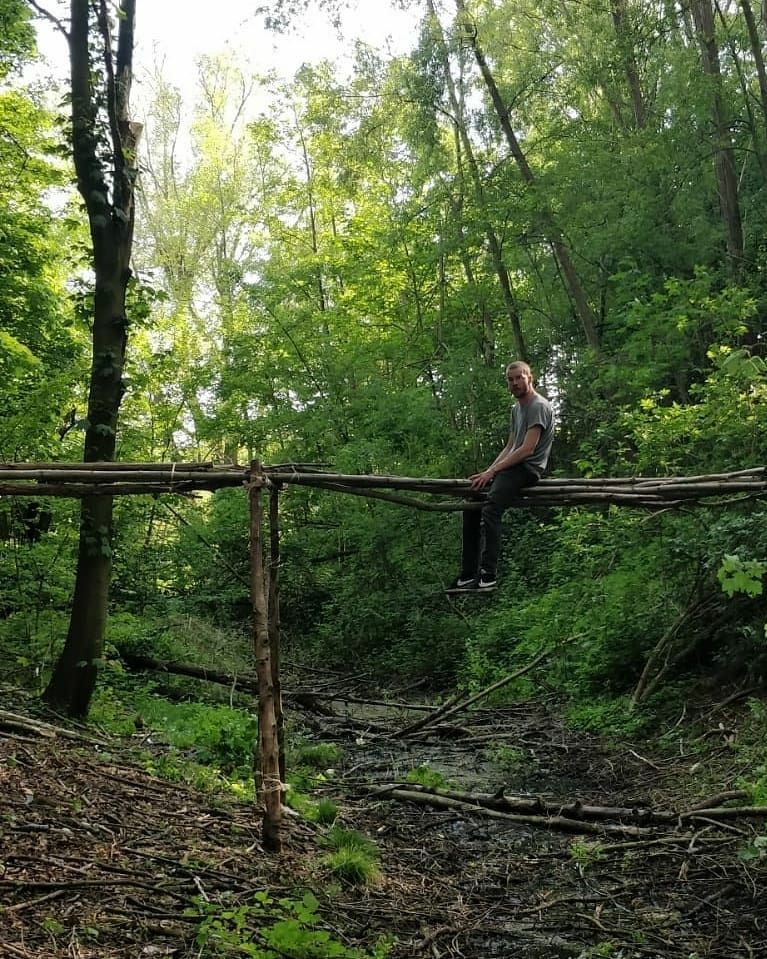
The photograph (see above, ed.) was taken when I recently ended up in a place in Ghent, wedged between the Scheldt, an access road to the E17 motorway and the Ghent-Brussels railway line: a secluded stretch of verges with a canal running between them. What appealed to me about this location was the isolated and lonely atmosphere that hung there amid the constant bustle of traffic. The contrast between the two fascinates me enormously. I experience a kind of peacefulness when I find myself in such an inaccessible place, surrounded by constant traffic. I want to work like a child exploring, like a pioneer close by. Going on an 'expedition' is almost reminiscent of building camps in the old days. The back-to-the-roots feeling is never far away in my work. That day, on a slip road off the E17, I started building and eventually made a bridge. A span between the verges.
Read more about tidal sidle (noun) - a furtive advance under the influence of tidal forces: the project by Sibran Sampers.