The research plan: Tim Theo Deceuninck
This interview is part of a series of interviews conducted at the start of Fieldwork III. They offer a glimpse into the practice of the participating artists and explore the way in which they approach their research projects. You can also follow the rest of their journey on this website. Here, Tim Theo Deceuninck speaks.
My research for Veldwerk builds on my interest in the photographic apparatus in relation to the landscape. When I started photography, I was very much preoccupied with the analogue: glass plates, silver nitrate, collodion, etc. A very chemical business. At one point, I was working on a project involving landscape photography and was confronted with the fact that I was working with techniques that are toxic to that same landscape. From that moment on, my entire practice has been a search for alternatives to reverse that chemical process into a sustainable practice.
In that research, I quickly came across Mary Somerville, a 19th-century scientist from Scotland. She developed a photographic technique based on plant material. At that time, all kinds of experiments were being conducted with photographic material, and Somerville's was successful but fragile. The photographs were not colourfast, and reproduction was not easy. The industrial revolution was in full swing and efficiency and large-scale production were becoming important requirements. Moreover, she worked primarily as a scientist and never really used her work for artistic or photographic productions. Because of this, and the fact that female scientists received little attention at the time, it took a while before she was recognised for her work. Her technique greatly influences my process and way of working, but also my way of life. In the spring, I harvest – mainly poppies, because they provide a deep contrast – in the summer I print, and in the winter I can do very little. That gives me time to read, do research, and organise the production of the past year.
Letter to Mary S., a publication by Tim Theo, dedicated to Mary Somerville
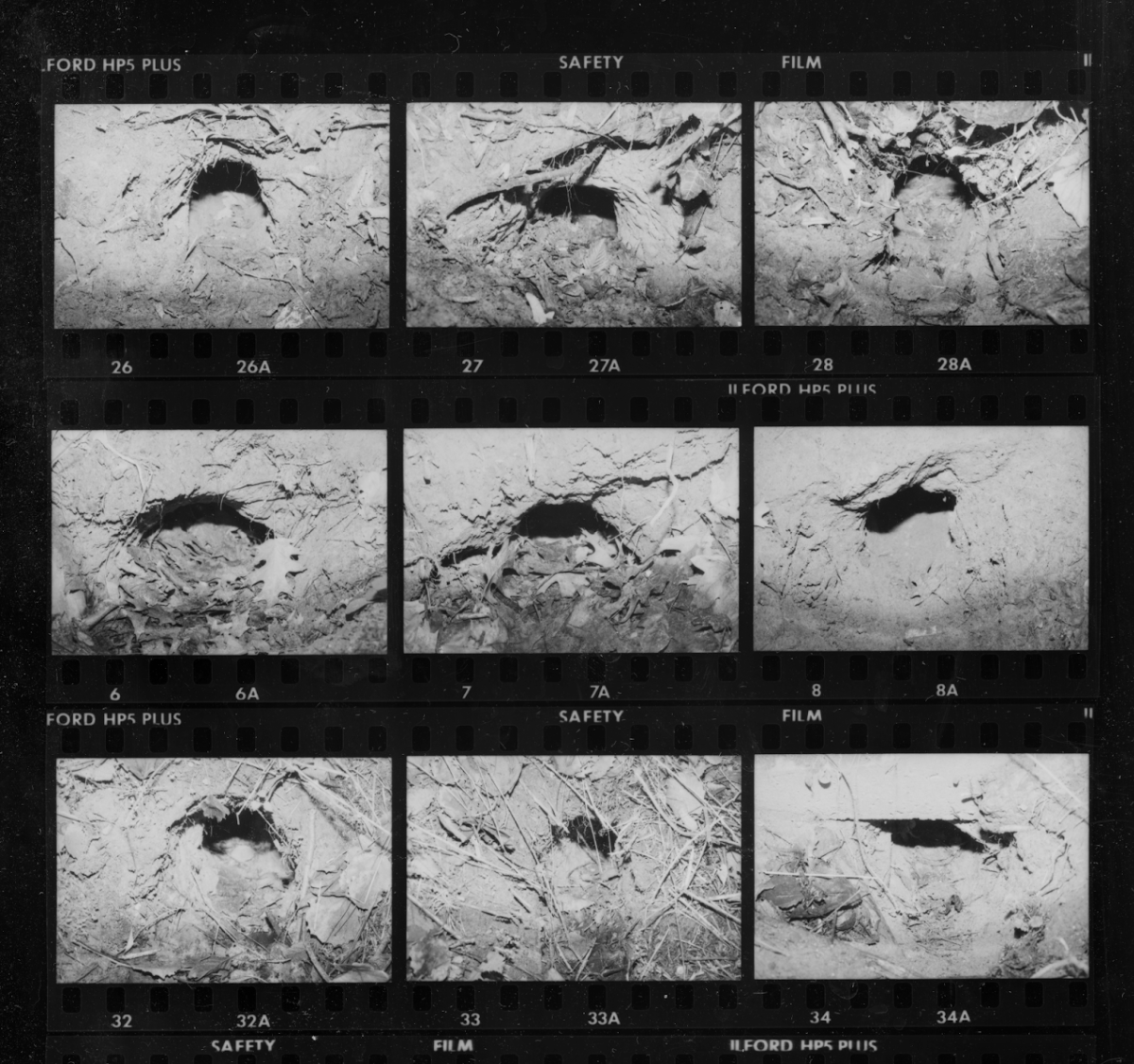
With my research for Fieldwork III, I want to go one step further. I want to use the landscape not only as material and as a theme, but also let it decide the framework. The relationship between photographer and subject is dubious; there is always something in between, it is always a representation, a mediation. Without each other, you are nothing. That is why I want to search for the absolute basis of photography – a black hole, the camera obscura – in the landscape: caves, rabbit holes, erosion... In themselves, these are rather banal places without much meaning, but they do offer a direct view of the landscape they overlook. Let me put it this way: I mediate a hole and try to determine as little as possible. Every hole I encounter is a potential camera.
It is a way of strengthening my relationship with the land and the soil. In this way, I want to break away from an aestheticised landscape. I am moving away from the typical photographic form, away from industry, raw materials, the romantic who wants to bring the spectacular landscape to the city, but also, for example, the fact that an image is square. Each of these things is a decision; there is always a form of control. The right time, the right white balance... I am looking for a rawness. The negatives are literally in the hole, so everything can transform. A beetle walks across the paper, it can get wet, there are so many factors that can influence it, beyond my control. There are also actors who have no voice. That raises the question of how I give a voice to the ground, through the landscape and through a medium. That is not obvious, and I do not necessarily try to provide an answer. But by working in this way, I force myself to constantly engage with it.
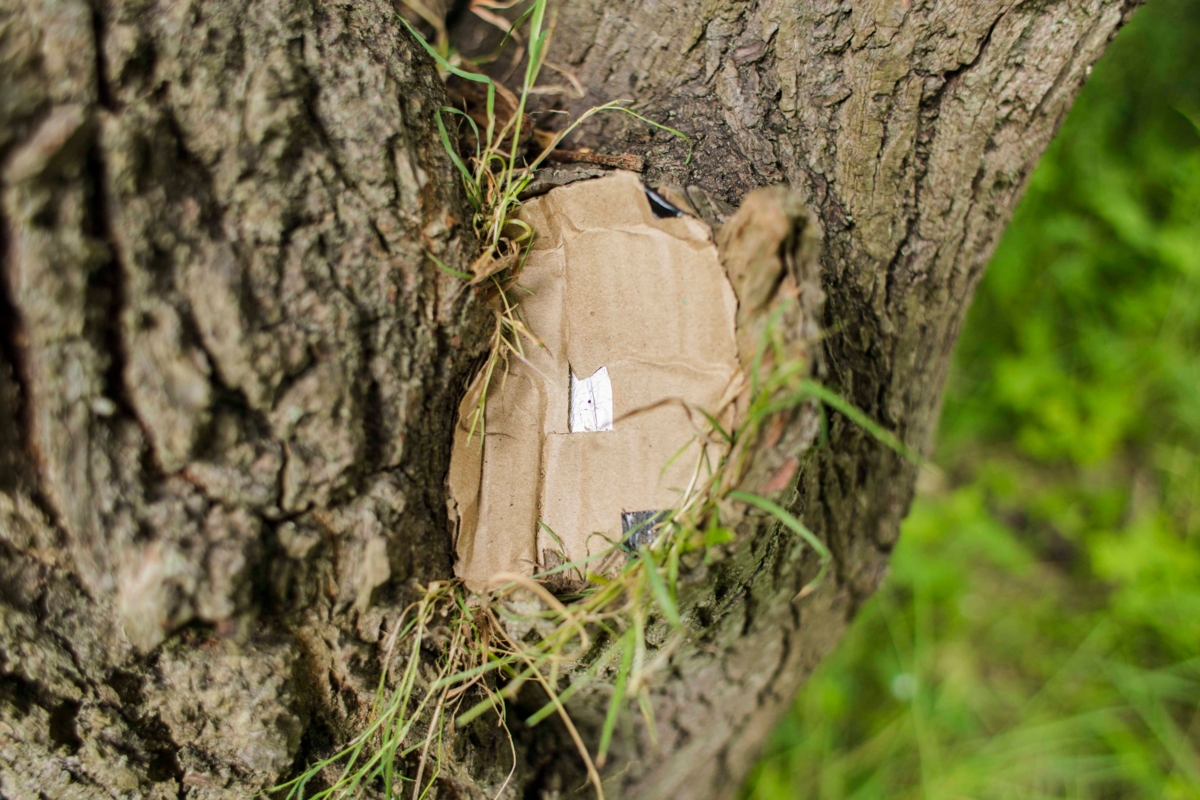
A camera by Tim Theo in the hollow of a tree © Leontien Allemeersch
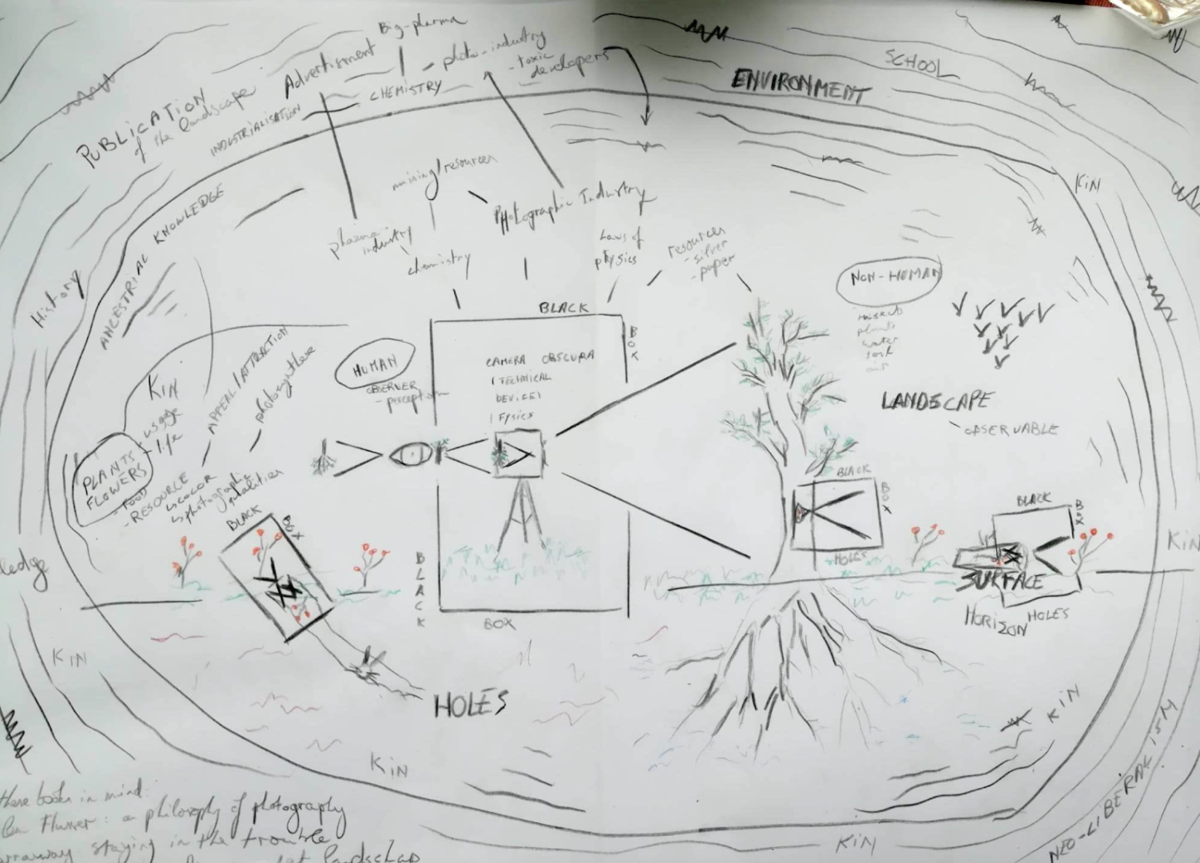
The way I work often starts from theory. I am less attracted to the theory that describes photography as a stillness or paralysis. The 'memento mori', as it is called. I want to do the opposite. I want to show the living, the circular. I find inspiration for this in Susan Sontag, Donna R. Haraway, Tom Lemaire, Robin Wall Kimmerer, and others. Flusser's Towards a Philosophy of Photography is also very important to me. In it, he describes photography as a black box influenced by a huge number of factors. Among other things, he highlights the entanglement between the pharmaceutical industry and the photographic industry.
I like to write after I have been working. At that moment, I think in a much gentler way about what it means to stand in a landscape. It may sound a bit vague, but on days like that, I literally spend the whole day touching plants. I feel the sap flowing in a tree. Normally, I am somewhat sceptical about this, but at that moment, while picking, there is something in that touch that transcends all theory. And then you write differently, more directly. You get less caught up in concepts.
Photography is often about being on the move, searching for places. That means a lot of solitary walks and slow actions. It invites you to slow down as a person too. Sometimes I spend three hours measuring a hole and installing my camera. I explain what I'm doing to passers-by who ask me. Usually, they ask me what the point of it is. I can't really answer that. Maybe it's just that they come to ask me that question? Or because it's good to do something completely useless every now and then?
I find it difficult to define exactly what rural means in my practice. I lived on the streets in a van for a while. I assumed I would travel around and go into the mountains, but in fact I hardly ever went into 'nature'. I mainly found intermediate zones and immersed myself in those micro-environments. A roadside verge, a patch of forest between the fields where animals and plants retreat... Roads used to connect villages, but now they go around them. Those big roads cut straight through the landscape. It's a patchwork quilt where city, nature and the rural are constantly connected. Flemish landscape tourism is a striking example of this. For example, the Kruibeekse polder, just outside Antwerp, has a dam where they simulate the tides of the Scheldt, thus creating a polder area. I think it is important to be aware of that tension.
Knowledge about organic dyes and working with plants is strongly linked to the idea of community. It is knowledge that is passed down from generation to generation and connects us to our ancestors. The community present in my work is both the community of historical rural life and the community of all actors, human and non-human, in the landscape.
Soon, I will invite all the artists from Veldwerk III to join me in the fields. It will be a good exercise to test what it means to harvest together for a photographic process, what new connections this can bring about, and how this collective harvesting can contribute to new harvesting rituals. These collective harvesting and working moments are something I would like to continue working on. In the past, I have already done many workshops on sustainable practices (making ink, making paper with organic materials, organic developers, etc.). I would like to expand this further in order to create a platform for alternative (photo)graphic applications, where sharing knowledge and creating new relationships between human and non-human actors is central.
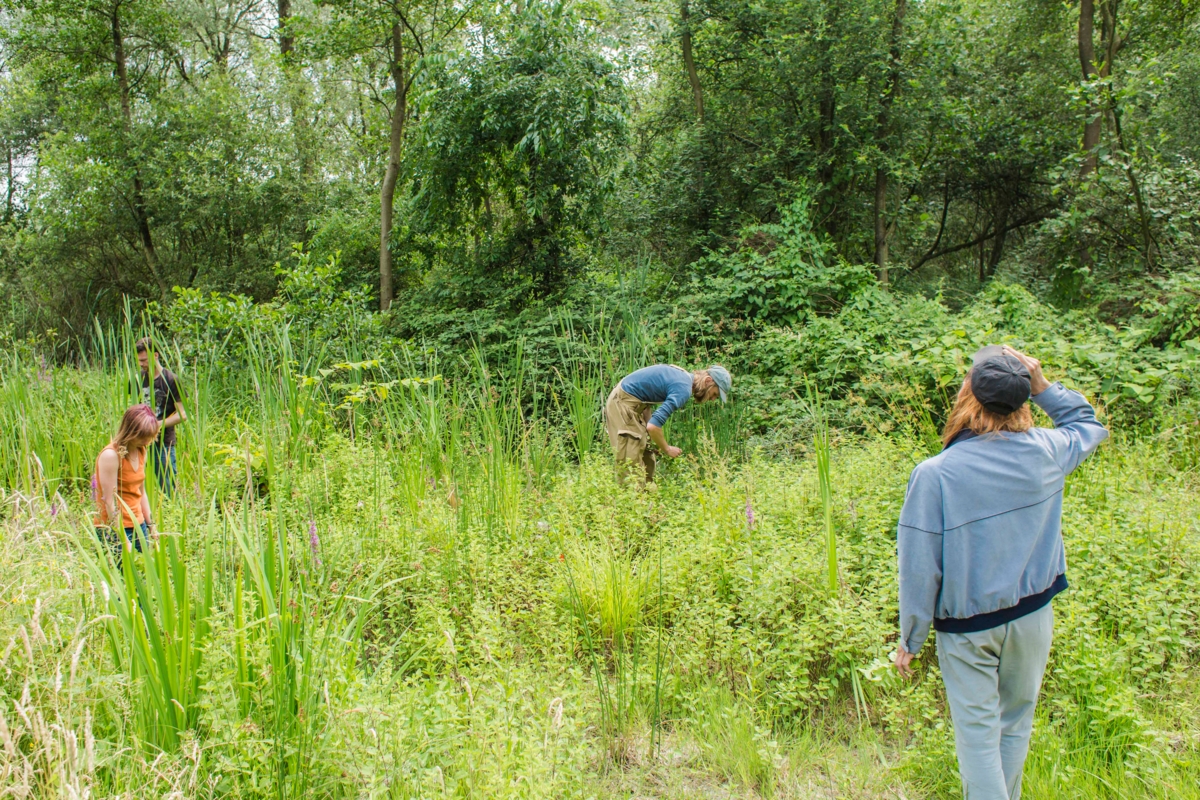
Collective harvesting during a gathering hosted by Tim Theo © Leontien Allemeersch
As a photographer, it is natural to work towards an end result, often in the form of an exhibition. But in my practice, that feels somewhat incongruous. Exhibiting is placing something in a new context, a form of aestheticisation. I am unsure how that relates to my research questions. Perhaps my work is better suited to a book? The advantage is that you can also share your method and your process. When I talk about photography, I tend to talk more about the how, the technical aspects, rather than the images I create. Most of the photographs I take are taken on the go and are very much tied to the moment of collection. A book offers more space to frame that process. Of course, the images also have a power of their own, but I don't want to be an exhibition photographer, nor do I need to be. In my previous exhibitions, I always looked for ways to broaden the format of an exhibition. For example, I placed plants in the space. The fact that I also have to pay attention to those plants at the opening creates a certain tension.
That's also what's fascinating about Veldwerk: it's not the end product that counts. Sometimes my negatives turn black because of a light leak or for some other inexplicable reason. In the beginning, I saw that as a failure, but not anymore. It's part of the process, and no day is ever wasted. The relationship with that place has still been established. I look forward to conveying that gentle way of thinking to others.
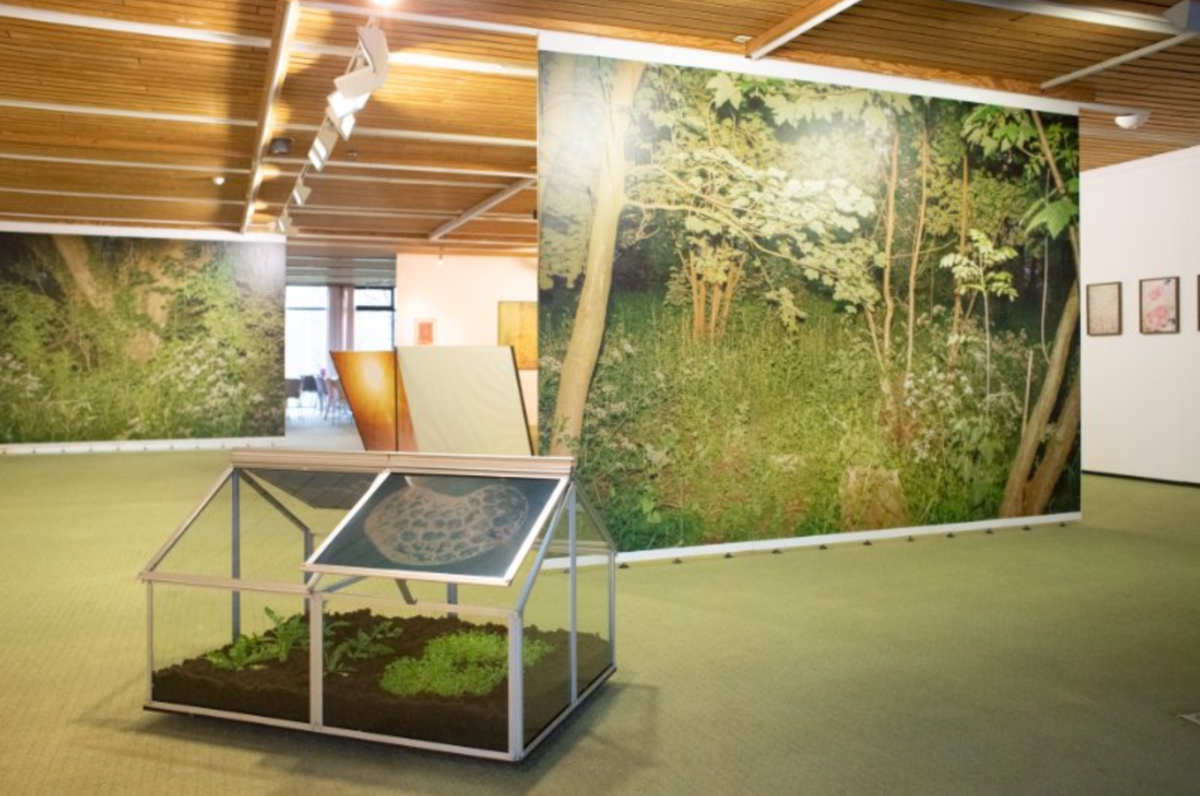
Exhibition by Tim Theo at cc De Schakel, Waregem
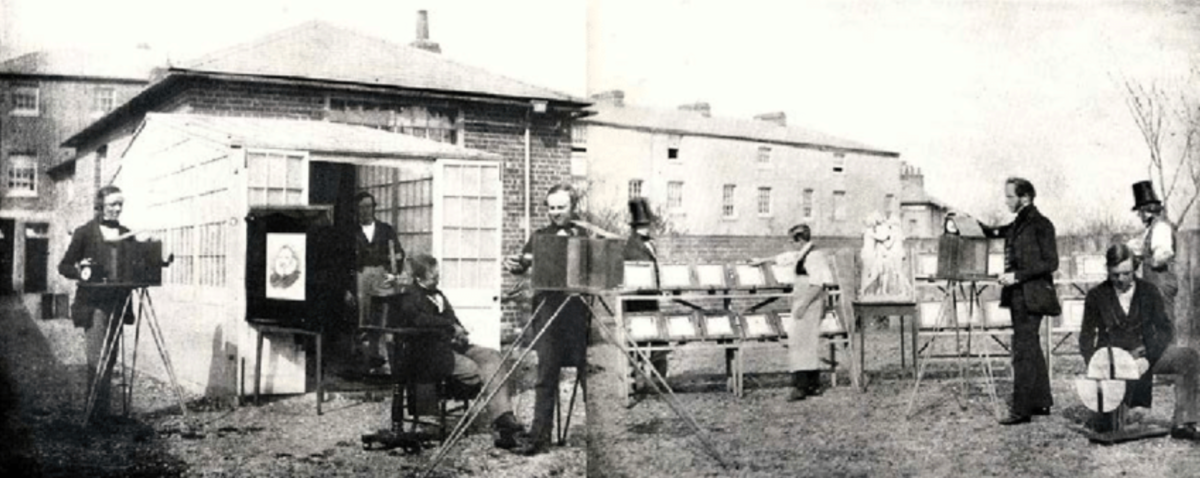
I have a special connection with this image by Henri-Fox Talbot, one of the founders of photography. This is his studio, where he makes contact prints in full sunlight. For me, it shows the essential relationship between natural light and man's urge to capture it. For the pioneers of photography, this relationship is captured in a delicate craft that requires a certain degree of care for the material. It often reminds me of my own workplace when I make exposures in full sunlight.
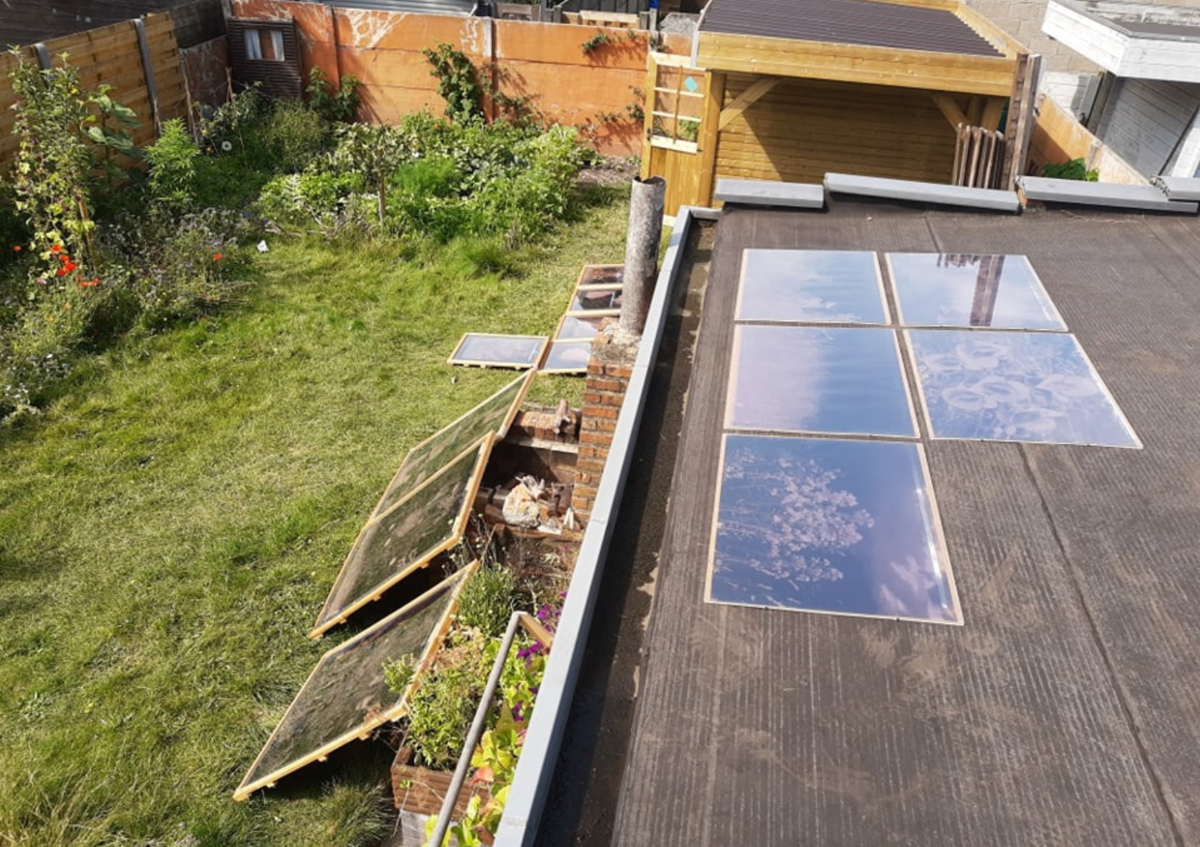
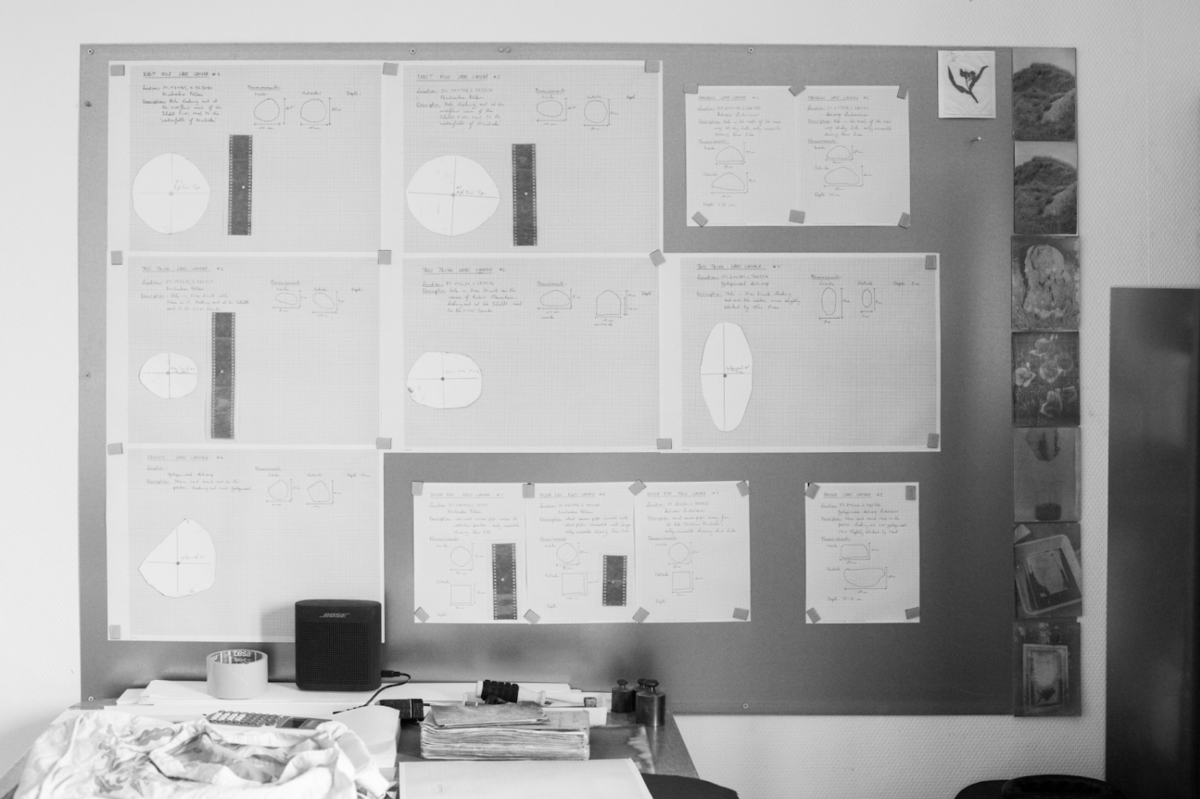
During Areaal (a learning network initiated by Kunstenplatform PLAN B) at Studio Devet, we mapped out our practice and how we work. It was interesting to give all the branches of my process a place. My studio is currently also a collection of measured 'gaps'.