Verslag Ten Gronde: Seeds in their Pockets - Carrying Resistance Between Ground, Seeds and Hands (Kunst & Zwalm)
Seeds in their Pockets: Carrying Resistance Between Ground, Seeds and Hands
Conversation report – Zwalm, 7 September
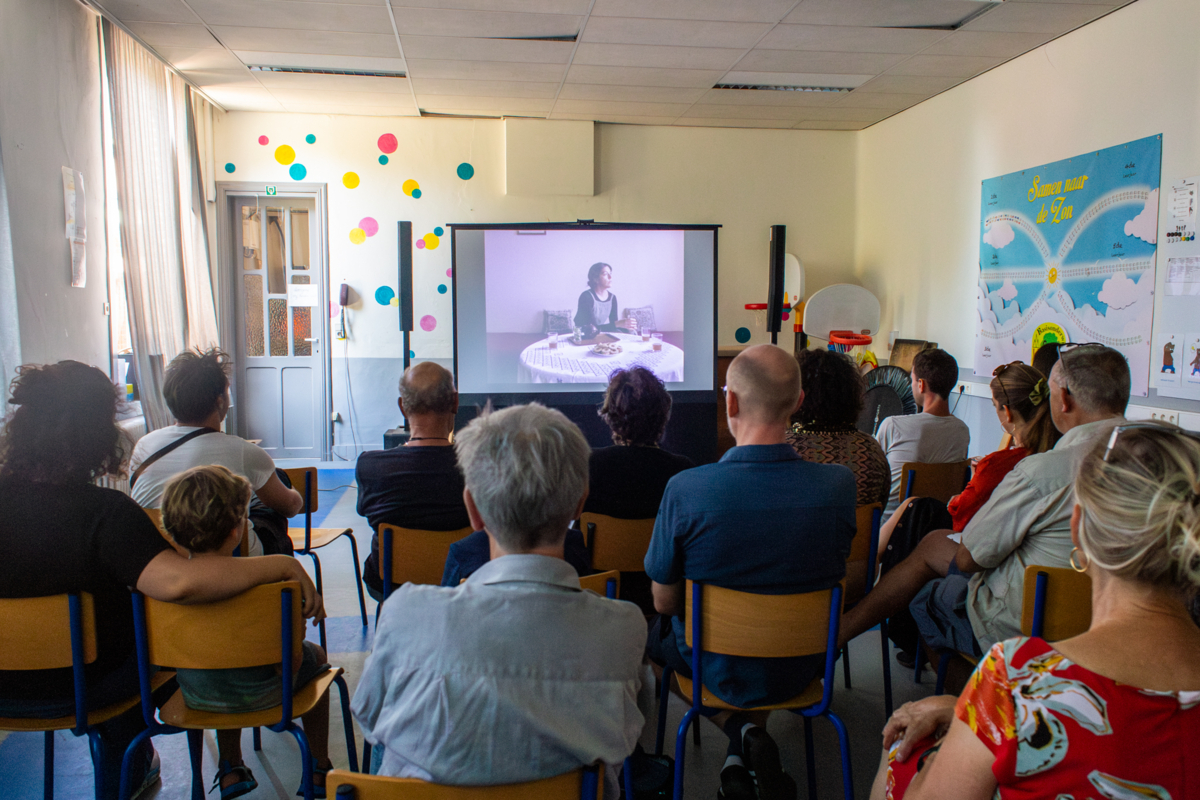
On Sunday September 7 The Post Collective’s Metaspora (Mirra Markhaëva, Elli Vassalou, Anna Housiada) invited the millers of Ijzerkotmolen (Jochen Delbeke & Emmanuel Meersschaut), alongside artist and chef Asli Hatipoğlu and filmmaker Dhiaa Biya, for a public discussion. This as part of Kunst & Zwalm, an art parcours that Kunstenplatform PLAN B curated and co-organised for one edition.
Growing through Biya’s film What Else Grows on the Palm of Your Hand? (2023), the gathering opened up a broader conversation about carrying seeds, recipes, crafts, and memory through the gestures of the hands — as tools of resistance and hope for both local and displaced cultures. Can artisanal practices become a space for cross-cultural solidarity, mutual flourishing and survival, and transgenerational care between humans and non-humans? How can we resist their commodification and ensure they remain accessible to all, transcending barriers of race, class, and legal status? You can read the report of the afternoon here below.
Gathering through gestures
A recurring image throughout the afternoon was that of the hand. Hands appeared not only as tools, but as carriers of embodied knowledge. What hands know is learned through repetition, touch and care, often outside formal systems of education. This knowledge resists full translation into language, machines or protocols. It survives through doing, and through being passed on in kitchens, fields and workshops.
Land, grain and the loss of complexity
From gestures, the conversation moved to the ground beneath them. Working with grain, seeds and land revealed how agricultural practices are deeply entangled with questions of access, privilege and belonging. Small-scale farming, milling and baking were discussed not as nostalgic returns to the past, but as continuous negotiations with weather, soil, time and community.
Against this backdrop, participants reflected on a broader loss of complexity in industrial food systems. What cannot be controlled or standardised is often removed. Seeds become uniform, processes are accelerated, and knowledge is fragmented across specialised roles. This simplification affects not only ecosystems, but also relationships: between farmers and bakers, producers and eaters, humans and non-humans.
Bread as process, not product
Bread emerged as a central thread weaving together many of these concerns. Bread-making was framed less as an outcome and more as a process of dialogue — with living organisms, changing environments and one’s own body. Fermentation, in particular, was understood as a practice that embraces multiplicity: microorganisms, flavours, rhythms and uncertainties.
At the same time, bread raised pressing questions about accessibility. Who has the time, space and resources to bake slowly? Who can afford food that is framed as healthier or more ethical? The conversation acknowledged that care for food and health can easily become a marker of privilege, even when motivated by collective values.
Resistance as another way of moving
The notion of resistance surfaced repeatedly, yet rarely as open opposition. Instead, resistance was described as taking another path: slowing down, staying with complexity, and refusing full optimisation. These choices, however, are not equally available to all. Returning to the land, engaging in artisanal practices, or living “closer to nature” often depends on class, legal status, geography and inherited knowledge.
Romantic images of rural life were questioned for masking the labour, precarity and exclusions that accompany such practices. What appears as choice for some is necessity or impossibility for others. Resistance, in this sense, is not a fixed position but a fragile, daily negotiation.
Carrying seeds across borders
Migration and displacement sharpened these reflections. For those who move across borders, connections to land and tradition are often interrupted. Yet gestures, recipes and skills continue to travel, carried in bodies rather than in documents. Seeds — literal or metaphorical — become vessels of memory and adaptation.
Within this context, Metaspora emerged as a way to think about belonging beyond rootedness in one place. It gestures toward forms of connection that remain mobile, relational and unfinished, allowing new dialogues between soils, traditions and practices to take shape.
Learning, sharing and common ovens
Throughout the conversation, the importance of community and shared infrastructure became clear. Practices such as baking, milling and seed-saving were understood as inherently collective. Sharing ovens, starters, harvests and knowledge counters the isolation of individualised consumption and production.
Education here was not framed as the transmission of information, but as the rebuilding of relationships: with food, with bodies, with others, and with non-human systems. Knowledge, like bread, gains value through circulation rather than accumulation.
Holding complexity
Rather than offering resolutions, the conversation closed by holding space for uncertainty. What we carry in our pockets, hands and habits shapes how we relate to land and to each other. Attending to small, often invisible gestures may not dismantle dominant systems overnight, but it cultivates conditions for care, resilience and mutual flourishing — across generations, cultures and species.