The research plan: Nina de Vroome
This interview is part of a series of interviews conducted at the start of Fieldwork III. They offer a glimpse into the practice of the participating artists and explore the way in which they approach their research projects. You can also follow the rest of their journey on this website. Here, Nina de Vroome speaks.
I discovered Bois-Du-Luc a few years ago, while travelling with my mother. We visited the mining museum and came across a cité that was still inhabited. While we were eating our sandwiches, we met a group of children playing. We told them we were from the Netherlands, to which they asked very sincerely whether we had colour television there too. For a moment, it seemed as if they lived in a closed world, far removed from reality. Of course, that's not really the case – after all, children always live a little in the closed world of their imagination – but it did make me think: that cité as a world unto itself.
I immediately made the connection with Louis Paul Boon's De vergeten straat (The Forgotten Street). That book tells the story of a dead-end street that is completely cut off from the world by the construction of a railway during the modernisation of a city. The people who live there create a microcosm, a utopian society. Because Bois-Du-Luc seems so isolated, I wonder whether a kind of miniature society existed here too, and how the form of this cité determines the way people live together. The underlying structure, formed by industry and a joint struggle for social rights, is gone. What remains is history and architecture. A history of demonstrations and common goals, an architecture focused on control. For example, the director's house was built so that he could overlook the workers' houses.
Every aspect of that place was conceived from an idealistic and paternalistic point of view. The exploitation of the workers was not only of economic importance, but also an ideological project. The management was like a father watching over the workers' lives. Social life was entirely organised by him: the café with its parish hall, the brass band, the church, etc. Most of the money earned in the mine was spent within the cité, creating a community that was controlled in every aspect. At the same time, you can also look at it through nostalgic glasses. Working conditions were appalling, but people were involved with each other. Now everyone lives more comfortably, but is fundamentally lonelier.
I want to approach Bois-Du-Luc from different angles. You can look at how the cité came into being from the perspective of the mine, from the point of view of history, but also from the point of view of tradition or folklore. For example, there is the procession of the statue of Saint Barbara. I find
the idea of a re-enactment to connect with history an interesting concept. In this way, you can literally bring history to life. The procession of Saint Barbara is a tradition that had almost died out but has now been revived, which in itself is almost a re-enactment of a religious tradition. I think it would be interesting to bring some aspects of mining history to life.
I found an important example of this in La Commune by film director Peter Watkins from 2000. The film is a historical re-enactment of the Paris Commune in 1871, in which a group set up their own community based on a more just system with equality between men and women, fairer wages for workers, collective decision-making, etc. The proletariat was played by workers and people with a migrant background. The elite was played by wealthy Parisians. Together with them, Watkins went through old texts and pamphlets, they read up on the subject and informed themselves. It was an invitation to enable political thinking. By re-enacting the events of 1871 through who they are today, the participants gained a very direct relationship with that history. Not only as something that is in the past, but also as something that still exists today and can be revived.
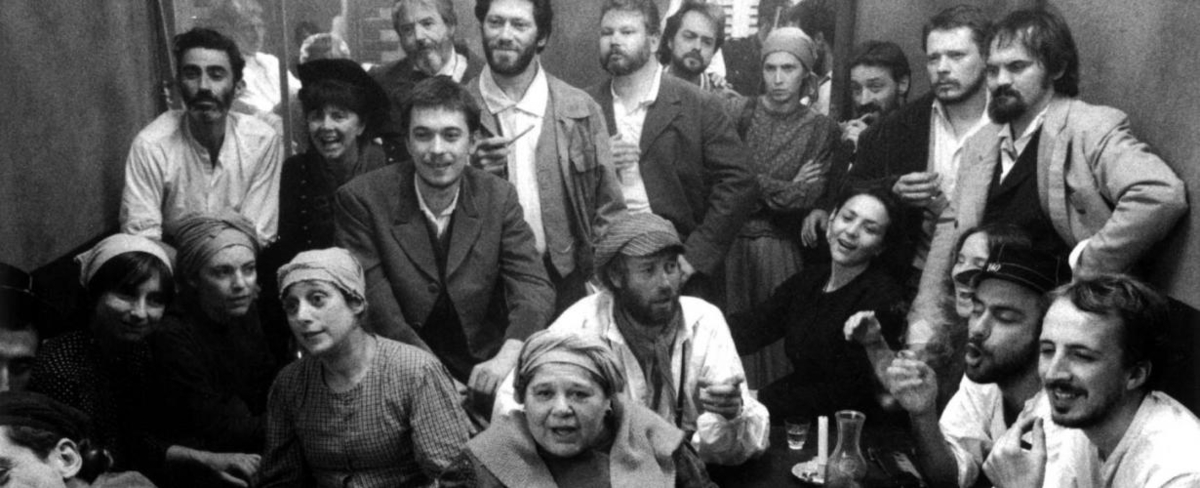
Still from La Commune, Peter Watkins (2000)
The inner gardens also offer an interesting perspective on the place. I wonder if there is any interest in starting a collective project there. I don't know exactly how this would work, but I would like to look for local collaborations. Musicians who want to organise a concert in the bandstand, someone who knows a lot about garden maintenance and wants to lend a hand... It's important that I don't organise everything myself, but also bring people into contact with each other. This may lead to new habits or lasting encounters, with the garden at the heart of a collective project.
Film is an interesting medium for bringing different perspectives together. It is a way of thinking about a place in audiovisual terms. It has something chaotic yet focused about it. I also write, but for me that is more a way of translating contemplative observations into text. Film is more unpredictable, more dangerous. You try things and are very vulnerable in doing so. That is exciting.
Moreover, it is a perfect alibi for talking to people and searching together. There is something performative about it, because as soon as you point a camera at someone, that person starts to 'do' something and it becomes a cinematic act. I tend to act ignorant, even though I've done my research beforehand. When I watch rushes of recorded conversations, I notice that I talk very little and leave long silences. Those openings encourage people to start talking. I let myself be guided by chance encounters that arise from my presence in the place.
I am often concerned with the relationship people have with 'nature' and our man-made environment. We create a fiction of nature around us, when in reality these are landscape, urban and political choices. Decisions are made everywhere about the size of nature reserves, how nature should be maintained, how land use can be made ecological, etc. In Belgium and the Netherlands, there is no wilderness. Nature consists of parks with or without fences around them. Experiencing wilderness is something else entirely. There, you feel that there is a world that does not need us. I grew up in a village, played a lot in the woods and got a sense of wilderness, of vastness, chaos and even a hint of danger. When I look at that environment now, I notice how much every plot of land is controlled and maintained. I realise that the experience of 'nature' in our country is mainly a fantasy evoked by children.
At the same time, there are movements that want to enhance that romantic image. Think of the BoerBurgerBeweging (Farmer Citizen Movement) in the Netherlands. They portray farming as a family affair on a farm with a few animals. That has little to do with reality. Farmers are actually forced to keep expanding, take out huge loans and invest heavily in automation and economies of scale. I find the fiction of farming and the political power of that image very interesting.
It is becoming increasingly difficult to give my naive view complete freedom. At the same time, I believe that as an artist, you are not a scientist. You should not try to become an ethnographer. Perhaps that is precisely why I find the documentary genre interesting, because it can have something very old-fashioned and didactic about it: it can show a piece of the world, as if you were sitting in a classroom. In my latest film, Globes, I experimented with that didactic language. How can I explain things in a beautiful way and translate that into a cinematic experience? When you think about how to explain something, it also challenges you to think about form. For example, where do you need a close-up to enlarge something and make it clearer? Film is always a schematisation and reduction of reality. If you take that reduction as your starting point, you arrive at an interesting question. Many films or documentaries try to approach reality as closely as possible, without showing that it is only a fragment. I find it interesting to focus on that fragment. That's why I like to literally zoom in on things, so you can see how the fragments form a whole.
Bois-Du-Luc appeals to me because of its apparent simplicity. Viewed from above, it is a cross, a very schematic shape. I can imagine working with vignettes that together form a fragment of that place.
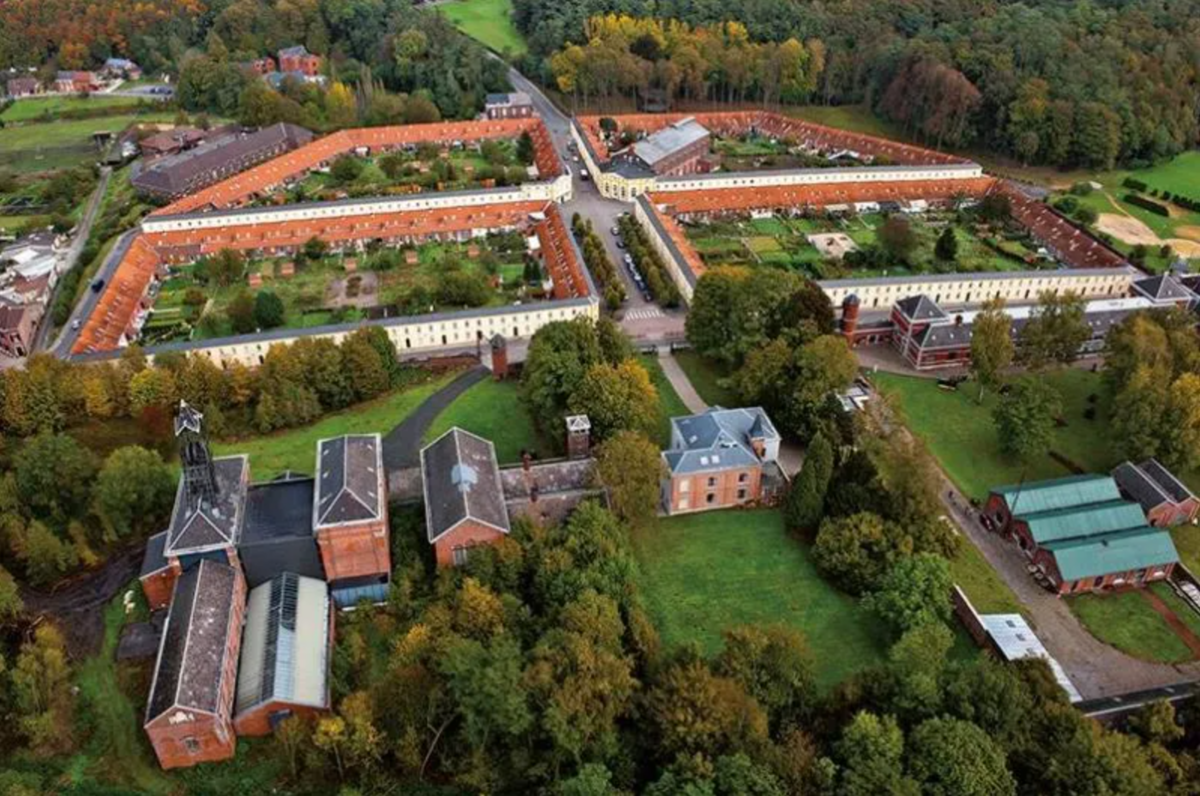
Here you can see a photo of the cité: the workers' houses are located around the cross. If you go south, you will come to the director's house, which overlooks the main road of the cité. To the left of that is the entrance to the mine. Note that the miners always walked past the director's house on their way to work. The location of the director's house was the most prominent feature in the layout, not the mine itself. This says a lot about the concept of the cité. The director's house was the centre of gravity, not the mine. The director was the director of the workers' lives. He controlled, paid, dismissed or hired, and organised the entire lives of the workers. Every day on their way to the mine, they were reminded of this.
What is also striking are the large green spaces in the middle of the blocks of houses. There are a number of trees, small garden sheds and they are divided into individual plots. I wonder what these spaces were used for in the past, whether there was or is communal land and what it is used for. Do children play there, are vegetables or fruit grown there?
There are also no cars to be seen in the photo. Perhaps there are now a few under the row of trees in the main avenue. The cité was not built for people with cars. People walked from home to work, from work to the café and the shop. There was much less of the outside world than there is now. People lived their lives in the cité. Today, people are much more connected to the surrounding villages and towns and travel much greater distances. I wonder how the current residents experience their geographical isolation or separation. How are they connected to the outside world now?